
For decades, the Red Sea was treated as infrastructure. A corridor. A passage connecting production and consumption. Ships entered from one end, exited from the other, and the system held. That assumption no longer holds.
What is unfolding in the Red Sea is not a disruption of trade routes. It is the emergence of a control layer — a space where access, timing and flow can be shaped, restricted or leveraged. The geography has not changed. The function has.
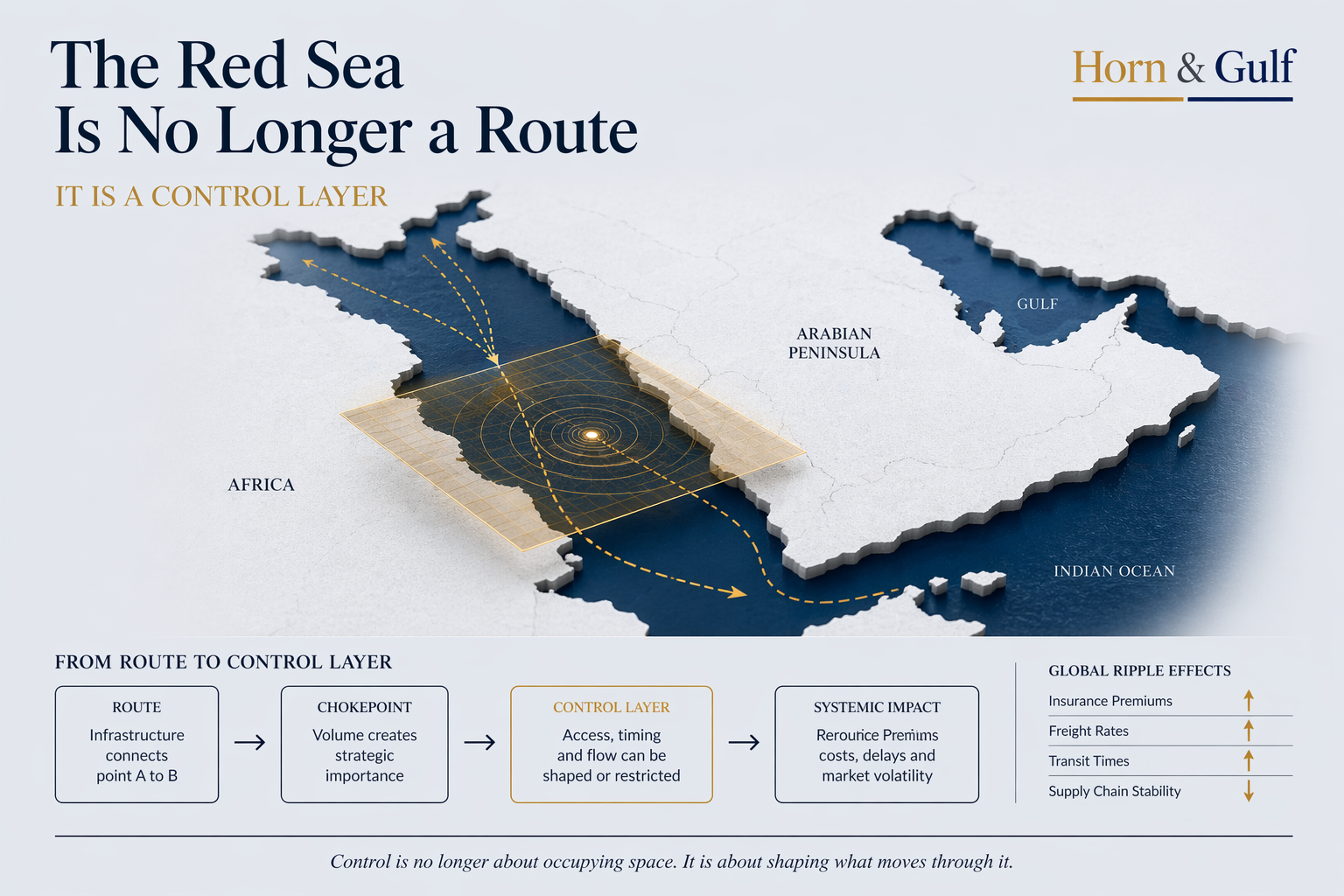
This shift is visible in how relatively limited actions have produced outsized global effects. A small number of actors, operating from constrained territory, have been able to alter shipping patterns across continents. Rerouting decisions taken in the Red Sea now ripple into insurance markets, freight pricing and supply chain timelines far beyond the region itself.
This is not because the Red Sea has become more important. It is because it has become more controllable. Historically, chokepoints mattered because of volume. Today, they matter because of optionality. The ability to disrupt without occupying, to influence without dominating, has redefined how power operates in maritime space. Control is no longer exercised through presence alone, but through the credible ability to intervene.
This distinction matters. In a traditional framework, stability meant securing territory. In the current environment, stability depends on maintaining continuity of flow. These are not the same thing. A corridor can be geographically secure and still functionally unstable if the flow through it becomes uncertain.
The Red Sea illustrates this clearly. Ports remain operational. Infrastructure remains intact. Yet the system is under stress because predictability — not capacity — has been compromised.
What we are witnessing is not the breakdown of a route, but the reclassification of that route into something more strategic. A control layer sits between infrastructure and power. It determines not just whether goods move, but how, when and at what cost.
This has broader implications. First, it changes how risk is assessed. Traditional models focused on territorial conflict or large-scale disruption. The current model must account for persistent, low-intensity interference that produces systemic effects.
Second, it alters the hierarchy of actors. Influence is no longer proportional to size or formal authority. It is tied to position within the system — particularly proximity to key nodes and chokepoints.
Third, it reframes resilience. The question is no longer whether a route can be kept open, but whether the system can absorb variability without cascading disruption.
In this context, the Red Sea is not an isolated theatre. It is part of a wider architecture that includes the Gulf, the Horn of Africa and the Indian Ocean trade network. What happens here does not stay here. It propagates. This is the analytical mistake often made: treating events in the Red Sea as episodic rather than structural. The route still exists. Ships still pass through it. But its function has changed.
It is no longer a passage. It is a layer of control.