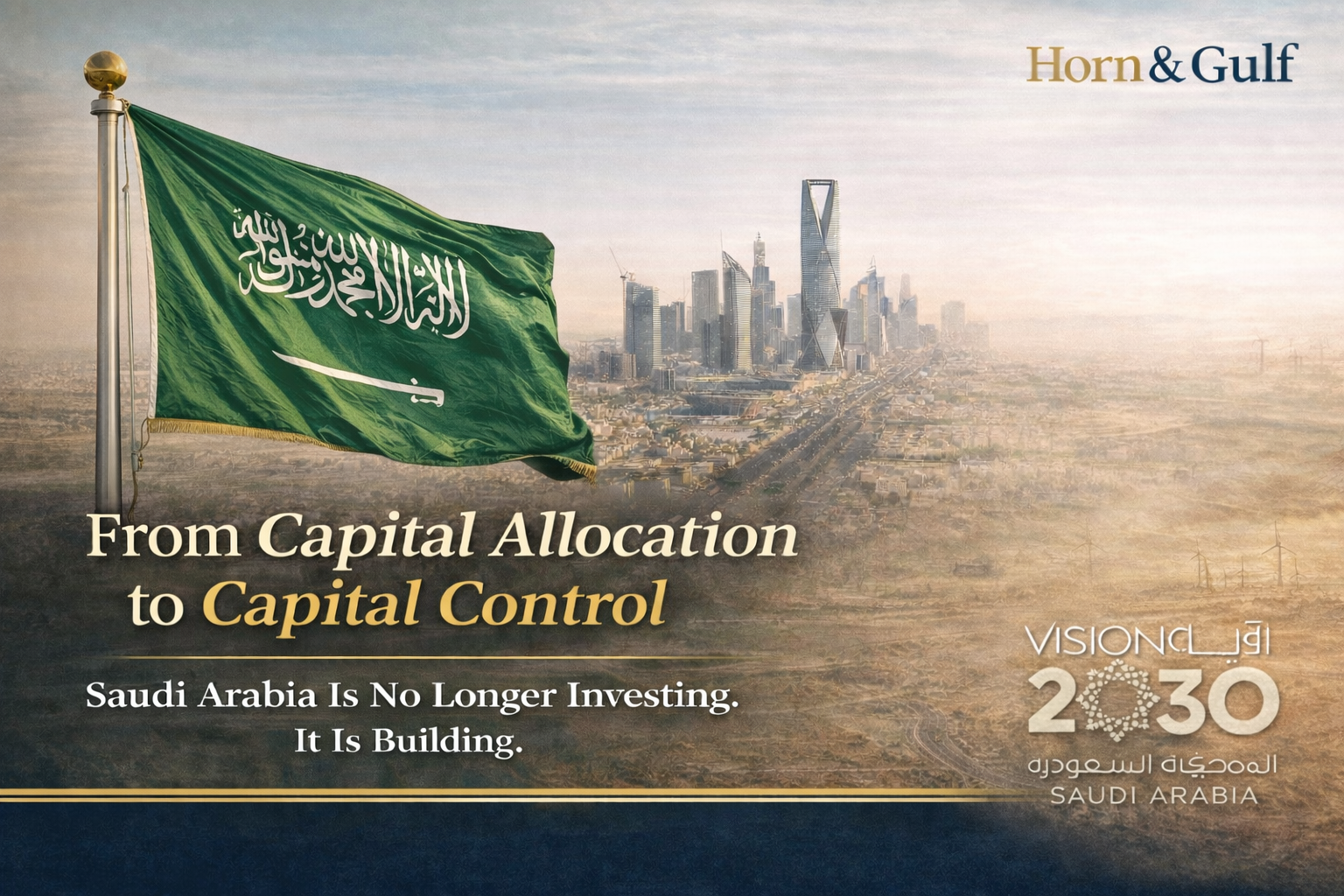
Saudi Arabia’s Public Investment Fund is no longer positioning itself as a global buyer of assets. The shift outlined in its new five-year plan signals something more structural: capital is being redirected from acquisition toward control, from exposure toward construction. This is not a tactical adjustment. It reflects a deeper recalibration in how the Gulf reads risk, return, and long-term sovereignty.
For most of the past decade, PIF operated as a high-visibility allocator of capital across global markets. Stakes in technology, mobility, entertainment, and infrastructure were not only financial bets but also signals of integration into the global system. Capital moved outward, returns were externalized, and strategic positioning was tied to access. That model worked in an environment where global liquidity was abundant and geopolitical friction, while present, remained manageable.
That environment no longer exists in the same form.
The past few years have exposed the fragility of interconnected systems. Sanctions regimes have expanded beyond states into networks. Supply chains have proven vulnerable to disruption at single points of failure. Financial flows have become increasingly subject to political alignment. In this context, capital that is merely invested is exposed. Capital that builds, owns, and operates is anchored.
PIF’s pivot toward value creation reflects this distinction. The language of the plan—localization, sector development, domestic capacity—is not about diversification in the traditional sense. It is about internalizing the drivers of value. Instead of relying on external markets to generate returns, the fund is now tasked with engineering those returns within the Saudi economy itself.
This shift changes the role of capital entirely. It moves from being a passive participant in global growth to an active architect of national systems. Infrastructure, logistics, tourism, manufacturing, and technology are no longer adjacent sectors; they become interconnected layers of a single economic design. Capital is deployed not to capture value where it exists, but to create it where it is needed.
The timing of this transition is not accidental. Oil revenues remain strong, but their predictability is no longer sufficient as a foundation for long-term strategy. Energy markets are increasingly shaped by political risk, supply disruptions, and shifting demand patterns. At the same time, the global investment landscape is becoming more selective, with capital gravitating toward jurisdictions that offer not just returns, but stability, legal clarity, and strategic positioning.
In this environment, the Gulf is not simply attracting capital. It is competing to structure it.
Saudi Arabia’s approach suggests that attracting capital alone is no longer the objective. The priority is to direct, shape, and ultimately embed that capital within a domestic framework that can withstand external shocks. This is a more demanding model. It requires execution capacity, regulatory coherence, and the ability to translate large-scale investment into functioning economic ecosystems.
It also carries risk. Building sectors internally is slower and more complex than acquiring exposure externally. Returns are less immediate, and the margin for error is narrower. But the trade-off is control. In a fragmented global system, control over production, supply chains, and capital allocation becomes a form of resilience.
This is where the broader regional context matters. Across the Gulf, similar patterns are emerging. The UAE continues to position itself as a hub for capital inflows, particularly in real estate and financial services, while simultaneously expanding its role in logistics and trade infrastructure. Qatar maintains a more conservative investment posture, but with increasing emphasis on strategic sectors. The direction is consistent: capital is being reoriented toward structures that reduce dependency on external volatility.
Saudi Arabia’s scale, however, makes its shift more consequential. PIF is not just reallocating capital; it is redefining how capital interacts with the state. The fund becomes a mechanism through which economic policy, industrial strategy, and financial deployment converge. This blurs the traditional boundaries between investor and policymaker. It also raises the stakes. Success is no longer measured solely by portfolio performance, but by the ability to generate sustainable economic capacity.
From a Capital & Risk perspective, the implication is clear. The Gulf is moving beyond the phase where it passively absorbs global capital. It is entering a phase where it actively reshapes how that capital is deployed, what it builds, and where value is ultimately realized.
In practical terms, this affects how the region should be read by investors and operators. The question is no longer simply where returns are highest. It is where capital is most effectively integrated into a system that can endure.
Saudi Arabia’s pivot is an early signal of that shift. It suggests that in a world defined by fragmentation and competition, the advantage will not belong to those who allocate capital most widely, but to those who anchor it most effectively.