A naval blockade of Iran is often presented as a clean economic mechanism: cut off oil revenues, restrict foreign currency inflows, trigger a currency collapse, drive inflation, and force the regime to the negotiating table. On paper, this logic is not wrong. Iran’s dependence on energy exports and external financing is real, and disrupting oil flows would create a significant macroeconomic shock.
The problem is not where this analysis begins — it is where it stops. Because the Iran question has never been purely economic. It sits at the intersection of energy markets, maritime trade, proxy networks, and great power competition. Treating a blockade as an “economic pressure tool” is, at its core, a misclassification. It is not an economic instrument. It is a systemic intervention.
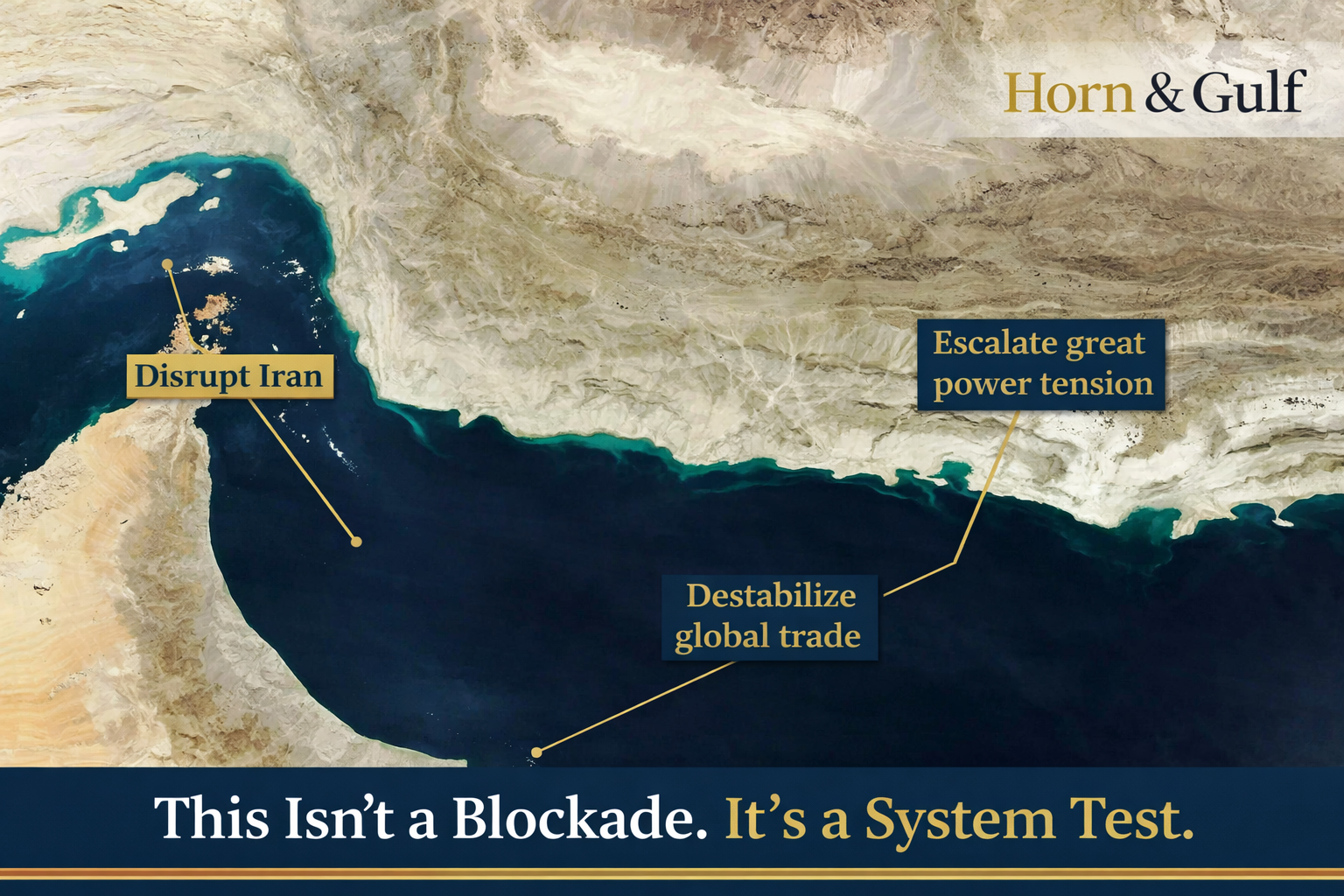
Start with the mechanism itself. Disrupting Iran’s oil exports does not only affect Tehran’s fiscal position. It immediately increases the risk premium on global energy flows passing through the Strait of Hormuz, a chokepoint through which roughly one-fifth of the world’s oil supply moves. The issue is not what Iran loses, but how much instability the system absorbs.
This leads to the second layer: response capacity.
Iran is not a conventional naval power, but it does not need to be. Its strategy is asymmetric by design. Mining operations in the Gulf, harassment of commercial shipping, and, more importantly, pressure through proxy actors across the Red Sea corridor are all viable responses. What we have seen recently through the Houthis is not an anomaly — it is a preview. In this context, a blockade would not trigger a purely economic response. It would provoke a broader disruption of maritime trade routes. At that point, the question shifts from Iran’s economic resilience to the fragility of the global logistics system.
The third layer is great power alignment.
A blockade of this scale is not a simple sanction. It is a form of maritime control, with significant implications under international law. This raises an immediate question: what does China do?
China is the primary buyer of Iranian oil and a central node in global supply chains. Cutting Iranian exports is not just an energy issue for Beijing — it is a strategic pressure point. Passive observation is unlikely. Even without direct military escalation, China can respond by accelerating alternative trade networks, bypassing sanctions, and expanding non-dollar financial channels.
Which brings us to the fourth layer: the financial system.
Every aggressive sanction regime aimed at Iran may weaken Tehran in the short term, but it also contributes to the long-term erosion of the dollar-centered global system. These measures incentivize the development of parallel payment infrastructures and sanction-avoidance mechanisms. In other words, while the target weakens, the system itself begins to evolve.
The fifth and most critical layer is behavioral.
The assumption that economic pain leads to political compliance is rooted in a specific model of rationality. But regimes like Iran do not operate strictly within that framework. Economic pressure does not automatically translate into policy change. In many cases, external pressure strengthens internal consolidation. The regime can absorb economic cost while converting external threats into domestic legitimacy. The equation “economic collapse equals negotiation” is theoretically clean, but empirically unreliable.
This raises the core question: Is the objective truly to bring Iran to the table, or to reshape the regional balance?
Because when we look at the likely outcomes, the second interpretation becomes more convincing. A blockade would not simply isolate Iran. It would reshape the Gulf–Red Sea corridor, push energy prices upward, place additional pressure on European and Asian economies, increase inflation across emerging markets, and raise the cost of global trade.
This is not targeted pressure. It is broad systemic intervention. The situation cannot be reduced to a simple outcome where Iran loses and the West gains. A more accurate framing would be: Iran comes under pressure. The global energy system absorbs stress. Trade routes become more fragile. Great power competition accelerates.
And the resulting equilibrium is far more complex than the initial objective.
The real question, therefore, is not how much Iran can endure.
It is how much the system can.