For years, the Gulf was understood through a narrow lens: a region defined by oil, bounded by geography, and vulnerable at a handful of critical chokepoints. That model is no longer sufficient.
What is unfolding across Yemen, the Red Sea, and the Horn of Africa suggests something more structural. The Gulf is no longer operating as a fixed geography. It is expanding into a system.
From Territory to System
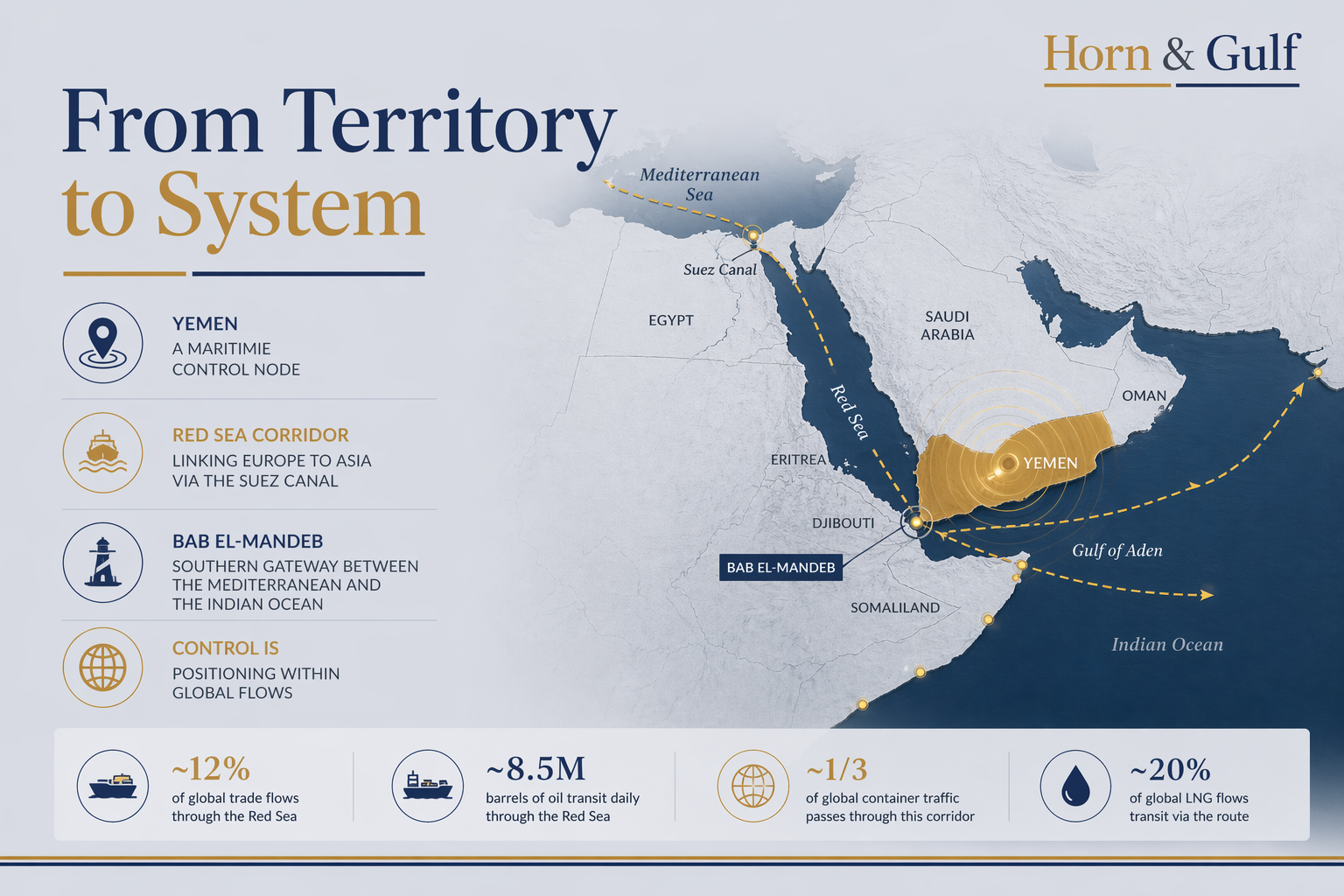
The Gulf today cannot be mapped by borders alone. Its operational footprint stretches beyond the Arabian Peninsula—into Yemen, across the Bab el-Mandeb, and deep into the ports of the Horn of Africa.
Yemen, in this context, is no longer just a conflict zone. It has become something else: A maritime control node. Its coastline is not peripheral. It sits at the intersection of two of the world’s most critical maritime corridors:
- the Red Sea, linking Europe to Asia via the Suez Canal
- the Bab el-Mandeb, acting as a southern gateway between the Mediterranean and the Indian Ocean
Control here is not about internal governance. It is about positioning within global flows.
From Chokepoints to Corridors
The traditional model of control in the region was simple: Secure Hormuz, and you secure the system. That model assumed concentration. One point. One risk. One lever.
The emerging model is different. Control is no longer anchored in a single chokepoint. It is distributed across a network of interconnected routes:
- Hormuz in the Gulf
- Bab el-Mandeb at the Red Sea’s southern gate
- Port infrastructure across the Horn of Africa
This is not redundancy. It is architecture. The system is being reshaped from a single-point dependency into a multi-node corridor structure. In this model:
Control is no longer held at a single point. It is distributed across a network. Disruption at one node does not collapse the system. It forces flows to adapt, reroute, and reconfigure. The objective is no longer to eliminate risk. It is to absorb it.
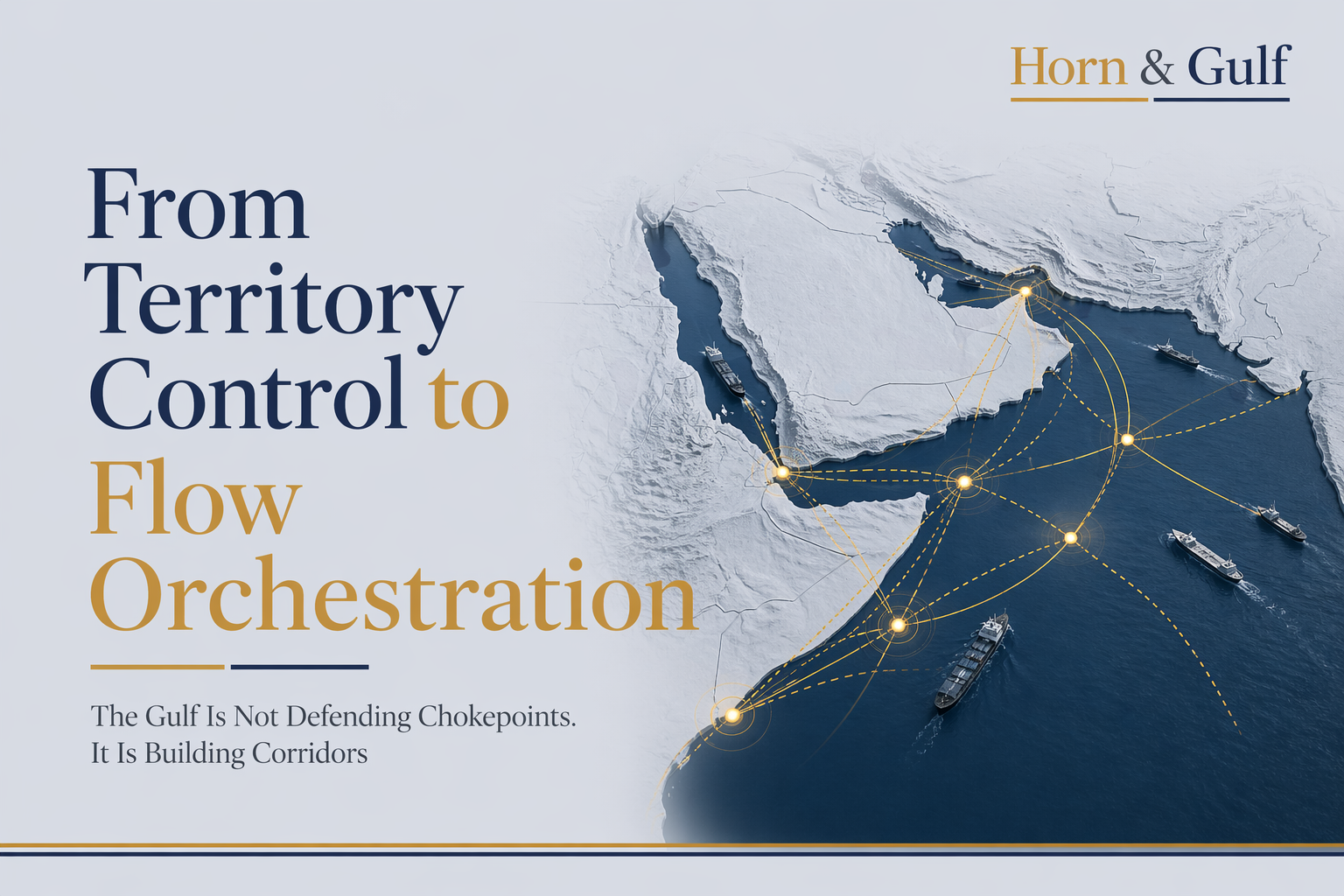
From Territory Control to Flow Orchestration
This shift is most visible in how regional actors engage beyond their borders. The strategy is not built on occupation or territorial expansion in the classical sense. It is built on connectivity.
Across the western edge of the system:
- port access in Eritrea
- logistical positioning in Somaliland
- operational presence in southern Yemen
- influence across Djibouti’s maritime ecosystem
These are not isolated moves. They form a pattern. Individually, each node offers limited leverage. Collectively, they create a controllable network of flows. This is not territorial dominance. It is system design. The objective is not to own land. It is to shape how goods, energy, and trade move across it. Not territory control, but flow orchestration.
A Region Redefined by Movement
What emerges from this structure is a redefinition of the Gulf itself. It is no longer a bounded region reacting to external shocks. It is an active system, extending outward, constructing alternatives, and redistributing risk.
Hormuz still matters. But it is no longer sufficient. The Gulf is not simply defending chokepoints. It is building corridors. And in doing so, it is shifting from a geography of vulnerability to a network of controlled movement.