The end of a war is often mistaken for the return of stability. In the Gulf, that assumption does not hold. What follows conflict is not resolution, but reconfiguration. The Iran war—regardless of how it is framed diplomatically—does not conclude the region’s volatility. It redistributes it.
Energy infrastructure remains exposed. Maritime routes around the Strait of Hormuz remain sensitive. Security pressures do not disappear. They settle into a new pattern. The system does not calm. It adjusts.
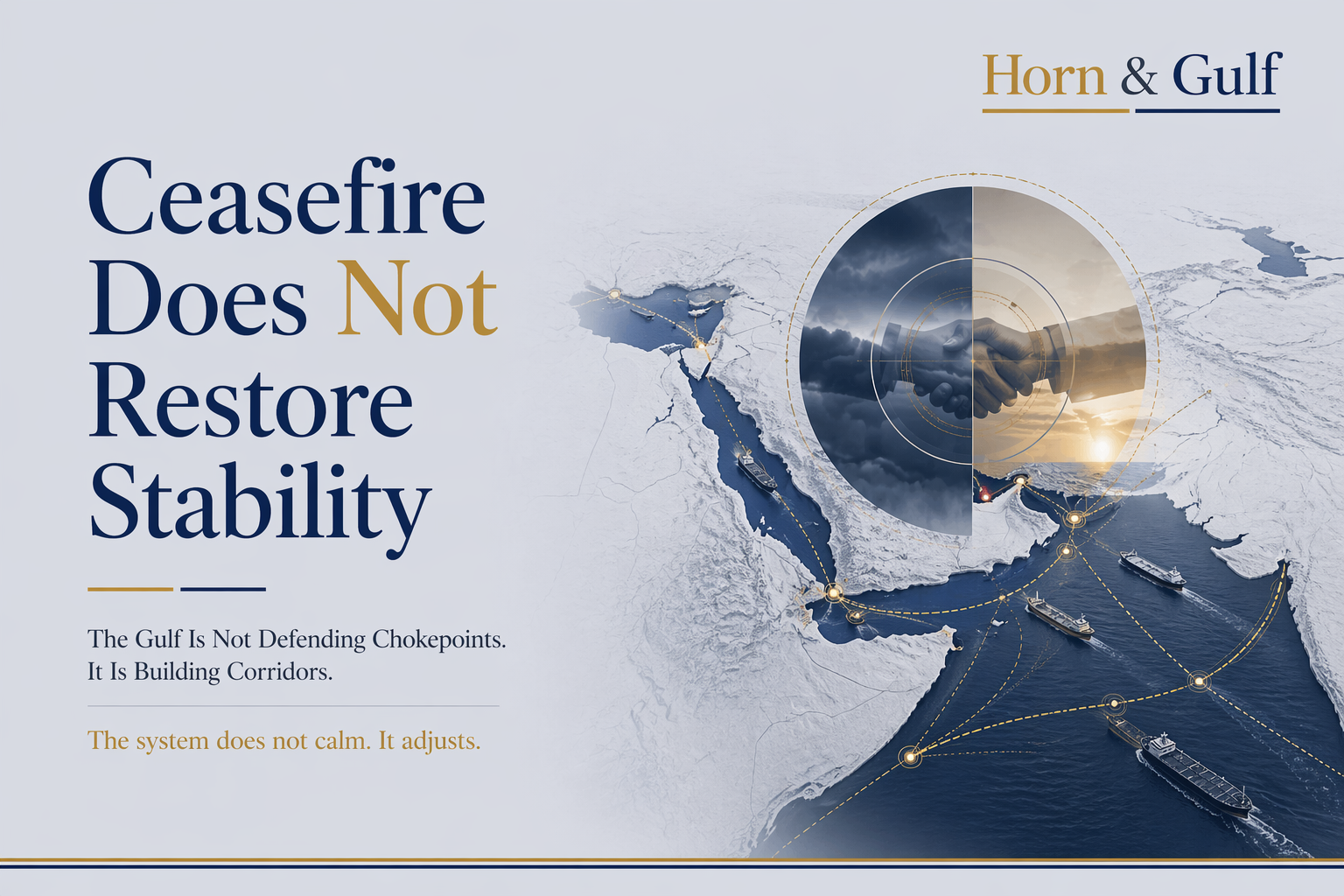
Ceasefire Does Not Restore Stability
A ceasefire signals the end of active confrontation. It does not restore equilibrium. Across the Gulf, post-war conditions do not resemble a return to normal. They reflect a transition into a different operating state. Shipping continues. Energy flows resume. Financial systems function.
But beneath that continuity, the structure has shifted.
- risk perception remains elevated
- security calculations become more cautious
- operational buffers increase
The region does not relax. It recalibrates. Stability, in this context, is not the absence of tension. It is the management of it.
A System Built on Managed Instability
What emerges is not instability in the traditional sense, but something more controlled.
The system continues to operate:
- ports remain open
- energy exports continue
- trade flows persist
Yet the cost of maintaining this continuity rises.
This is managed instability:
- risk is present
- but it is contained within acceptable thresholds
- operations adapt rather than halt
Instead of breaking under pressure, the system absorbs it. But absorption is not neutral. It introduces friction. More security layers. More routing considerations. More financial hedging.
The system works—but at a higher cost base.
The New Normal: Persistent Low-Intensity Stress
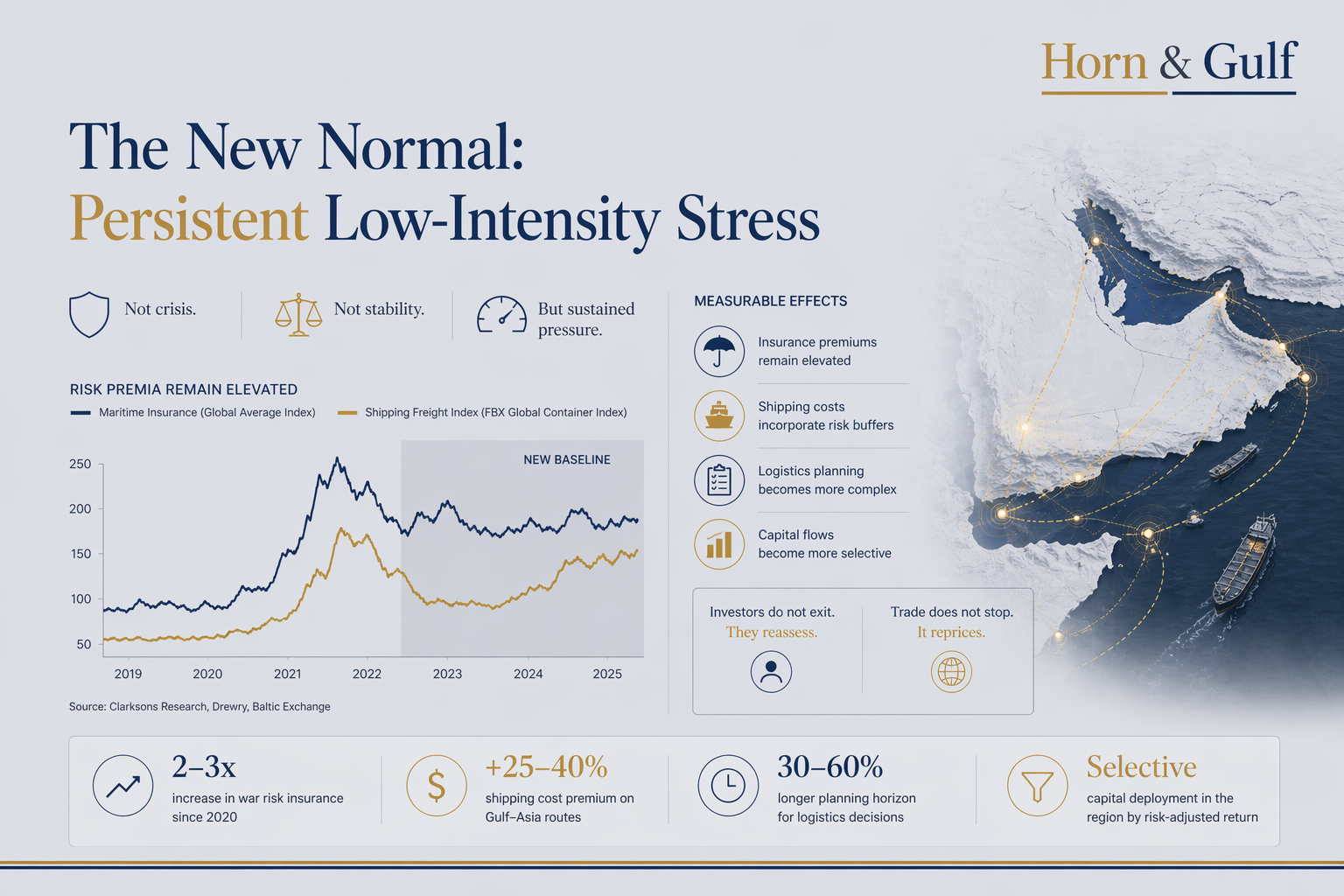
Over time, this produces a new baseline. Not crisis. Not stability. But sustained pressure.
This has measurable effects:
- insurance premiums remain elevated
- shipping costs incorporate risk buffers
- logistics planning becomes more complex
- capital flows become more selective
Investors do not exit. They reassess. Trade does not stop. It reprices. The Gulf continues to function as a global hub.
But it does so under conditions of continuous, low-intensity stress. This stress is not temporary. It becomes embedded in the system.
Conclusion
The expectation that systems stabilize after conflict belongs to an earlier model—one where disruption was episodic and recovery was linear. That model no longer applies. Today’s systems are designed to continue operating under pressure, not to eliminate it.
The Gulf illustrates this clearly. It does not move from crisis to stability. It moves from acute disruption to managed tension. The system is not stabilizing. It is learning how to operate under stress.