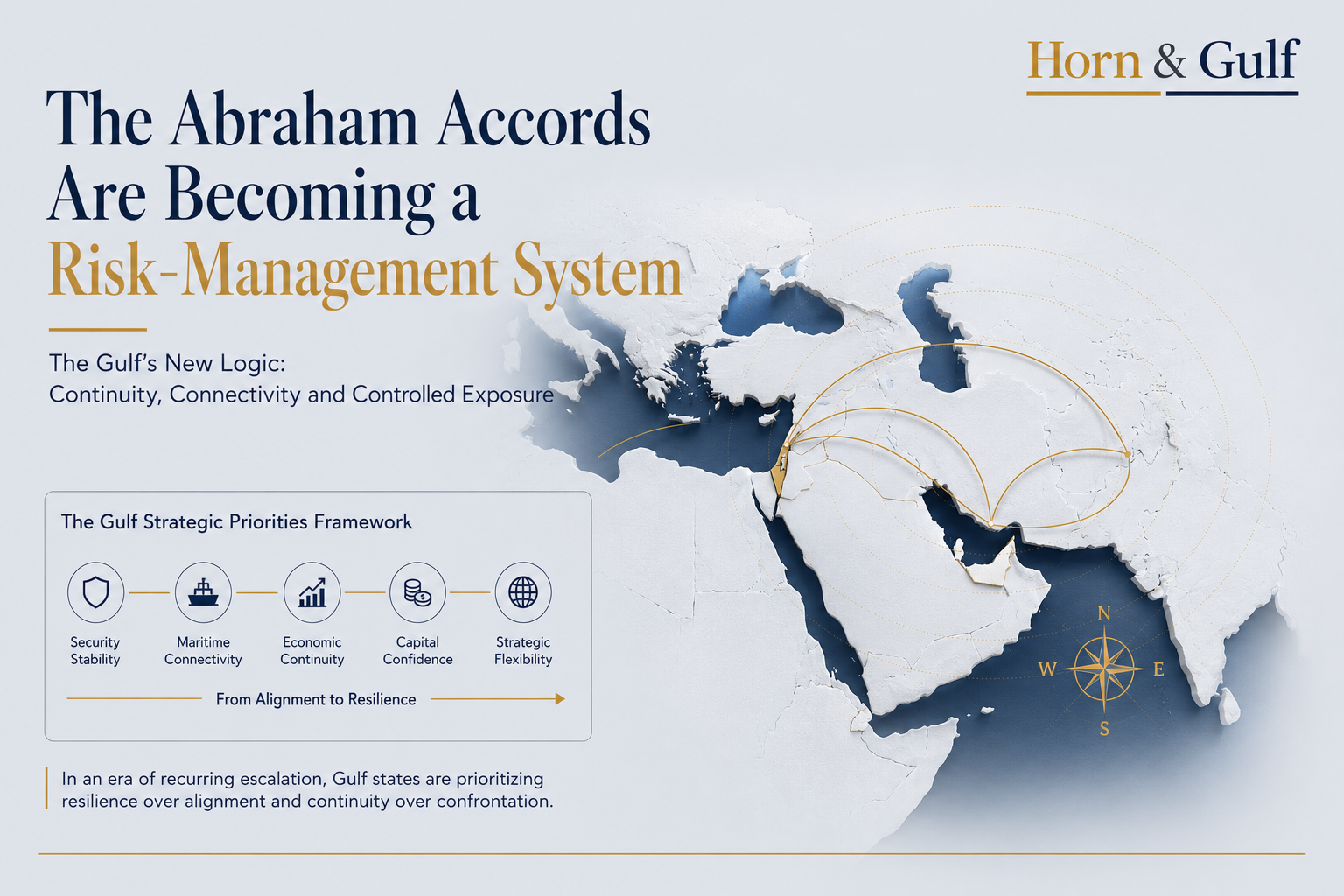
The Abraham Accords strategic shift is becoming increasingly visible across the Gulf. While economic engagement between Israel and Gulf states continues, regional priorities are increasingly centered on continuity, logistics resilience, capital stability and controlled geopolitical exposure rather than alignment alone.
For several years, the Abraham Accords were presented as the foundation of a new Middle Eastern order.
The assumption behind the framework was relatively clear: economic normalization between Israel and parts of the Gulf could gradually evolve into a wider strategic architecture capable of reducing regional tensions, stabilizing trade routes and integrating regional capital systems under a U.S.-backed security umbrella. That assumption is now under pressure.
The visible signal is not the collapse of relations between Israel and Gulf states. The deeper signal is more structural: Gulf states increasingly appear cautious about organizing their long-term regional security environment entirely around a single geopolitical axis.
The distinction matters. The Abraham Accords are not disappearing. But their function inside the regional system is beginning to evolve.
The Signal Was Never Normalization Alone
Much of the international discussion surrounding the Abraham Accords focused on diplomacy, symbolism and political optics. The White House ceremonies, the reopening of direct flights and the rapid expansion of investment partnerships created the impression that the region was entering a more commercially integrated and strategically pragmatic phase.
Part of that interpretation was accurate.
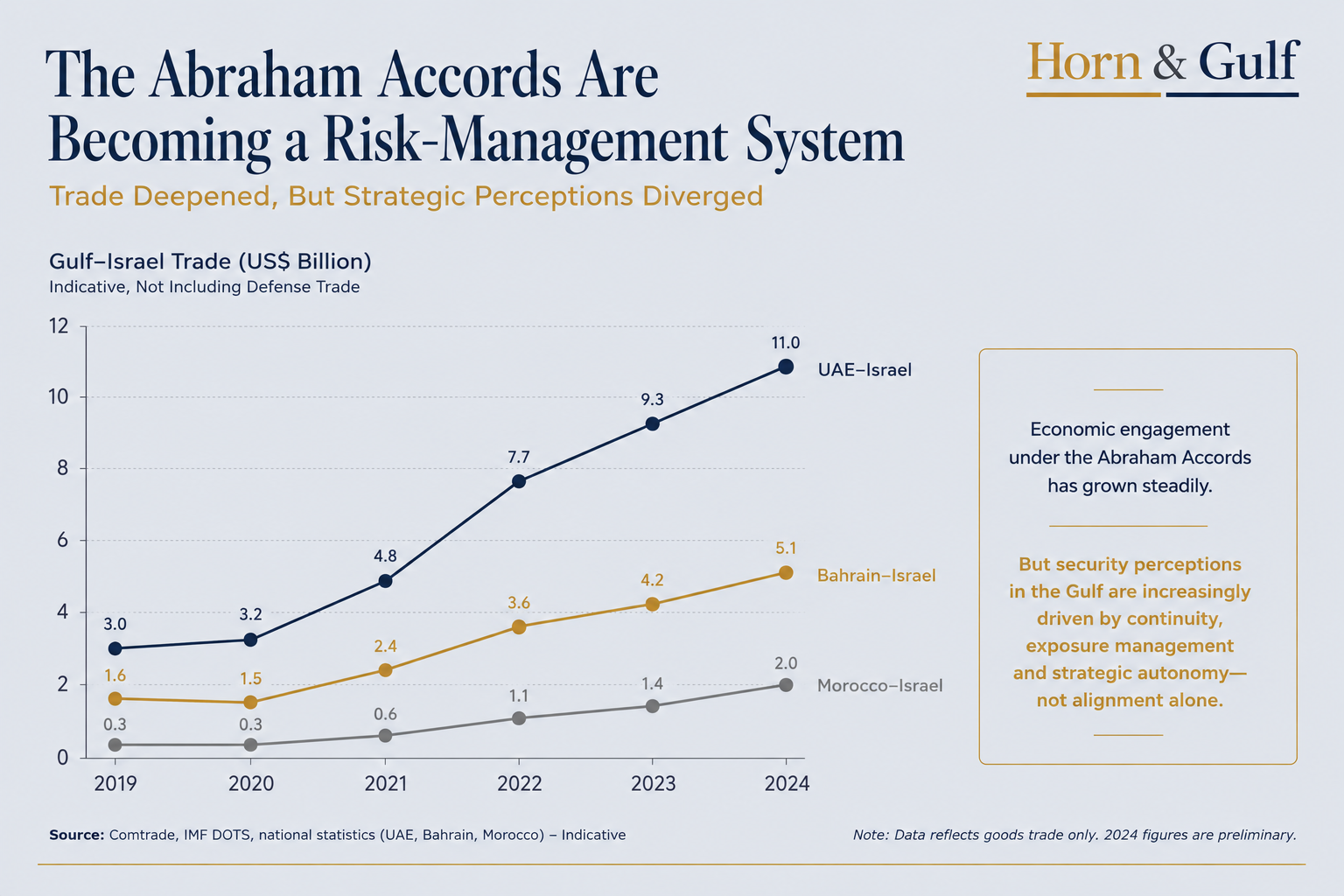
Trade expanded. Technology partnerships deepened. Security-related cooperation was reported to have expanded in selected areas, although the scope remains difficult to verify publicly. Gulf sovereign capital also increased engagement with Israeli innovation sectors, particularly in technology, logistics and infrastructure-linked industries.
At the same time, a significant part of the architecture underneath the Accords was linked to regional security calculations.
The central strategic assumption was that Gulf states and Israel shared overlapping concerns regarding regional instability and that this convergence could gradually evolve into a more durable framework for cooperation.
That is the part now being reassessed.
The Gaza war, regional escalation risks and repeated cycles of direct and indirect confrontation between Israel and Iran have highlighted a growing concern for Gulf capitals: deeper regional alignment can also increase exposure to broader escalation dynamics that affect economic continuity, investor confidence and logistics stability.
That changes the calculation.
The Gulf’s Strategic Priorities Are Increasingly Focused on Continuity
From a Horn and Gulf perspective, the most important transformation is not diplomatic rhetoric. It is the evolution of Gulf strategic behavior itself.
The Gulf today is not operating primarily as an ideological bloc. It is increasingly behaving like a system focused on preserving continuity.
That continuity includes:
- energy exports
- shipping flows
- aviation corridors
- insurance stability
- sovereign capital attraction
- logistics reliability
- tourism and financial confidence
This creates a structural tension with prolonged regional escalation environments.
For Gulf states, especially the UAE and Saudi Arabia, long-term economic transformation requires predictability more than prolonged geopolitical volatility. Mega-projects, logistics corridors, industrial diversification plans and financial-center ambitions all depend on controlled risk environments and stable international confidence.
This is where the regional logic begins to diverge from some of the earlier expectations surrounding the Abraham Accords. The Gulf does not necessarily need to reduce relations with Israel to limit exposure to regional escalation cycles.
Instead, it can gradually compartmentalize the relationship by separating economic and technological cooperation from broader geopolitical escalation dynamics. That trend is becoming increasingly visible.
The Region Is Becoming More Multi-Centred
One of the least understood developments in current Middle Eastern geopolitics is the transition from a relatively binary regional structure toward a more fragmented and multi-centred order.
The old model was easier to explain:
- a U.S.-aligned regional bloc
- an Iran-aligned regional network
- peripheral balancing actors
The current landscape is considerably more fluid.
Saudi Arabia is pursuing greater strategic autonomy while preserving its long-standing security relationships with the United States.
The UAE increasingly operates as a network power built around ports, finance, logistics, aviation and capital connectivity.
Qatar continues to maintain mediation relevance across multiple competing systems simultaneously.
Türkiye is attempting to strengthen its regional position through maritime doctrine, defense-industrial expansion and corridor politics.
Iran continues to preserve regional influence despite economic pressure and periodic strategic constraints.
Israel remains one of the region’s most capable military actors, but also faces growing questions regarding long-term regional integration under conditions of recurring escalation.
The result is not necessarily the emergence of a new stable order. It is the emergence of overlapping systems competing to shape regional influence, logistics access and strategic connectivity.
Maritime Geography Is Returning to the Center
One major blind spot in many discussions about the Abraham Accords is maritime geography.
The Middle East is often discussed through ideology, alliances and military confrontation. But the region’s deeper logic increasingly revolves around corridors, chokepoints and logistics resilience.
The Red Sea, Bab al-Mandab and Strait of Hormuz are no longer functioning simply as trade routes.
They are increasingly operating as strategic filtering systems that influence global shipping behavior, insurance pricing and energy risk calculations.
Every escalation cycle now immediately affects:
- insurance pricing
- rerouting behavior
- freight timing
- energy risk calculations
- port competitiveness
- sovereign risk perception
This is one reason Gulf capitals appear increasingly cautious about prolonged escalation environments. The region’s economic model is becoming more dependent on uninterrupted connectivity.
That includes:
- container flows through Jebel Ali
- Red Sea shipping continuity
- aviation reliability through Gulf hubs
- energy export predictability
- investor confidence in Gulf financial centers
Under these conditions, geopolitical escalation is no longer merely a security issue. It also becomes a pricing mechanism.
The Hidden Repricing Is Happening in Capital Markets
The most underpriced dimension of the Abraham Accords debate may not be diplomacy itself. It may be capital behavior.
Global capital increasingly evaluates the Middle East through operational continuity:
- Can ports function reliably?
- Can shipping routes remain open?
- Can insurance systems absorb disruption?
- Can sovereign wealth systems preserve investor confidence during periods of regional tension?
- Can Gulf cities continue operating as stable commercial nodes while surrounding systems face volatility?
These questions increasingly matter as much as summit declarations and diplomatic symbolism.
This is partly why Gulf financial centers continue attracting capital even during periods of regional instability. Investors increasingly differentiate between:
- localized conflict
- systemic disruption
- controlled instability
Gulf policy behavior increasingly suggests a preference for preserving controlled regional environments rather than allowing localized crises to evolve into wider systemic disruption.
That requires calibrated distance from uncontrolled escalation dynamics while preserving strategic partnerships.
The Abraham Accords Are Being Repositioned
The Abraham Accords are not collapsing. They are evolving from a transformational political narrative into a narrower strategic instrument.
Their future likely lies less in grand regional realignment and more in selective functional cooperation:
- technology
- air defense coordination
- trade
- logistics
- investment flows
- selected security coordination
But the assumption that the Accords alone could serve as the foundation of a fully integrated regional order now appears weaker than it did several years ago. The region’s deeper trajectory points elsewhere.
The Middle East is entering an era where states increasingly prioritize resilience, continuity and strategic flexibility alongside traditional alliance structures.
That does not eliminate partnerships. It changes how they are evaluated. And in the Gulf, pricing mechanisms often reveal structural change earlier than political language does.