IMEC and Blue Homeland reflect two different approaches to the same strategic shift: the growing importance of resilient connectivity systems. As trade routes, maritime chokepoints and logistics networks become more exposed to geopolitical risk, states are increasingly focused on how flows of trade, energy, data and capital are secured.
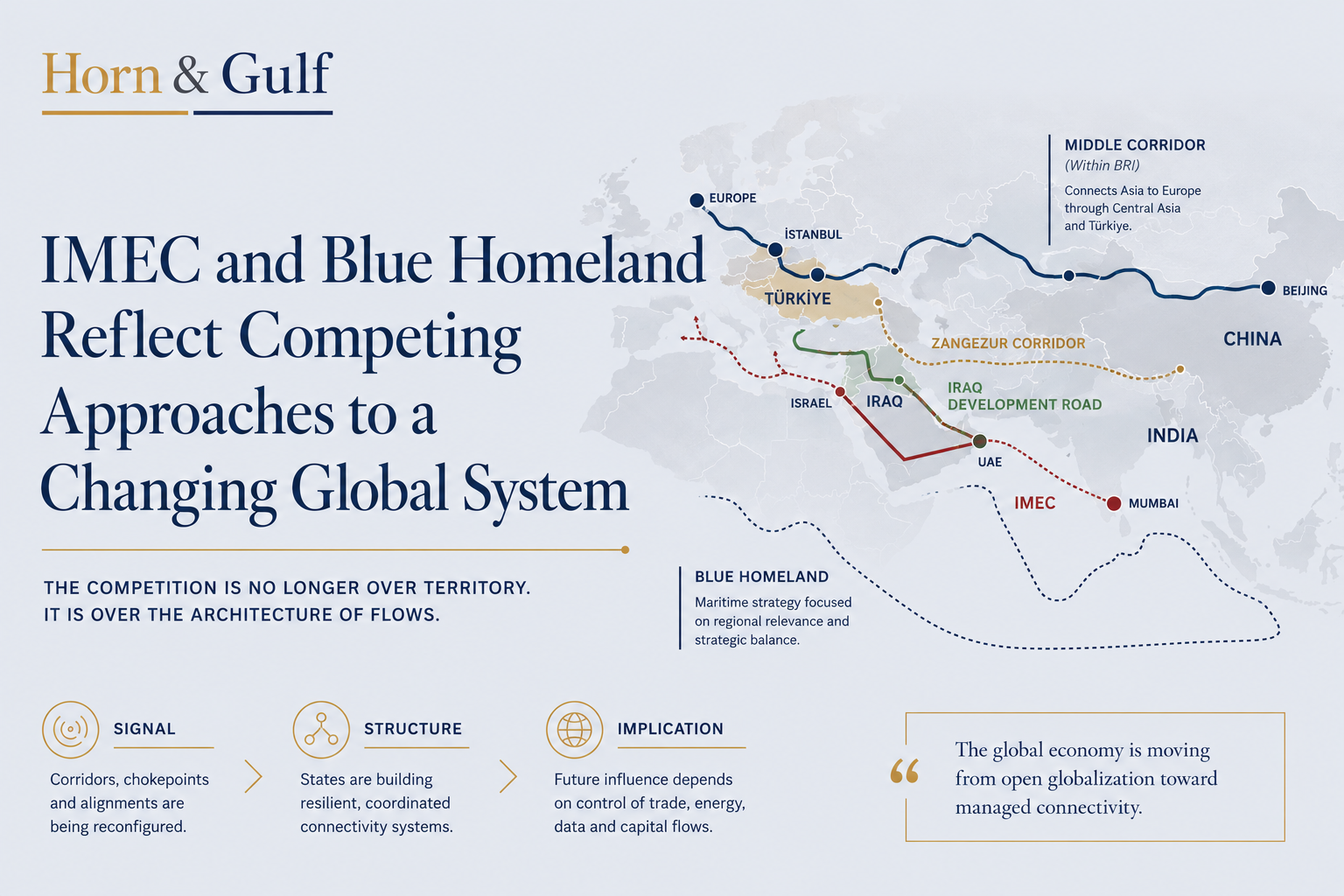
The visible signal is the growing strategic attention surrounding the India–Middle East–Europe Corridor (IMEC) and Türkiye’s broader maritime-geopolitical doctrine often associated with the “Blue Homeland” framework. The deeper structural reality, however, is that both are responding to the same global transition: the gradual fragmentation of the older globalization model and the growing importance of strategically coordinated connectivity systems.
At first glance, the two narratives appear to describe different geopolitical priorities.
IMEC is generally presented as a connectivity initiative centered on infrastructure, trade integration, ports, rail systems and digital corridors linking India, the Gulf and Europe. Blue Homeland, meanwhile, is more commonly associated with maritime sovereignty, naval positioning and Eastern Mediterranean competition.
Yet beneath the political language and media framing, both appear to be responding to a broader strategic concern.
Recent disruptions across the Red Sea, instability affecting maritime insurance markets, pressure on Suez traffic and wider geopolitical tensions have increased questions about the long-term resilience of global trade routes previously viewed as relatively open and politically neutral systems.
The issue is no longer only trade efficiency. Increasingly, it is also about how states secure and coordinate the infrastructure that enables trade, energy and logistics flows.
IMEC Beyond Infrastructure
Much of the discussion surrounding IMEC focuses on maps, ports, railways and investment agreements. Those dimensions are important, but the initiative may also reflect a broader effort to strengthen Gulf–Europe connectivity through more closely coordinated infrastructure, logistics and political partnerships.
This helps explain why the recent Greece–Cyprus–UAE diplomatic coordination attracted wider strategic attention.
The visible diplomacy focused on investment, technology, energy and infrastructure cooperation. From a strategic perspective, it may also suggest a broader effort to deepen Eastern Mediterranean connectivity between Gulf capital, European access points and emerging transport networks.
Discussions in Washington surrounding an Eastern Mediterranean Gateway framework appear consistent with this trend. Greece, Cyprus and the UAE are increasingly positioned not simply as bilateral partners, but as participants in a wider connectivity system stretching between the Gulf and Europe.
This evolving framework is not limited to shipping alone. It increasingly involves insurance systems, digital infrastructure, energy interconnectivity, investment coordination and supply-chain resilience.
In that sense, the corridor appears to be evolving beyond transport infrastructure into a broader strategic connectivity framework. The distinction matters because the global economy increasingly appears to prioritize resilience, strategic coordination and trusted logistics systems alongside efficiency.
Blue Homeland Was Also About Strategic Relevance
Public debates surrounding Mavi Vatan often focus narrowly on maritime disputes or naval posture in the Eastern Mediterranean. But the doctrine can also be interpreted through a wider geopolitical lens.
At its core, Blue Homeland reflects Türkiye’s effort to preserve long-term strategic relevance within regional trade, energy and transport systems.
The underlying concern has been that major Eastern Mediterranean connectivity projects could eventually reduce Türkiye’s centrality as a transit state between Europe, the Middle East and Asia.
From this perspective, Blue Homeland is not only about maritime boundaries. It is also about maintaining a meaningful role within the region’s evolving infrastructure and logistics architecture.
This partly explains why the Development Road project through Iraq has gained strategic importance alongside maritime positioning in the Mediterranean. Both can be understood as attempts to reinforce Türkiye’s role within regional connectivity systems.
From Ankara’s perspective, the challenge is not simply territorial. It is also logistical and economic.
The Broader Shift Is About Connectivity Systems
Much of the media framing surrounding these developments remains centered on traditional geopolitical narratives:
“regional rivalries,”
“strategic competition,”
or “new alliances.”
While such interpretations contain elements of truth, they may overlook the larger structural transition underway.
States across the Gulf, Eastern Mediterranean and wider Eurasian corridor system are increasingly trying to address the same strategic question:
How can economic connectivity remain resilient in a world where trade routes are becoming more exposed to geopolitical risk?
This helps explain why several seemingly separate developments are becoming interconnected:
- UAE investments in ports, logistics and AI infrastructure
- Eastern Mediterranean energy integration discussions
- Gulf sovereign wealth involvement in transport and maritime systems
- Red Sea and Hormuz contingency planning
- Türkiye’s transit and Development Road initiatives
- the growing importance of digital corridors and undersea cables
- maritime insurance repricing linked to regional instability
Together, these trends suggest that the global system may be moving toward more managed and strategically coordinated forms of connectivity.
Maritime Geography Is Being Repriced
One of the least discussed dimensions of this transition is the changing strategic value of geography itself.
Recent Red Sea disruptions demonstrated that maritime chokepoints influence not only shipping flows, but also insurance calculations, energy pricing, investment behavior and supply-chain planning.
This is gradually changing how states and investors think about infrastructure. Ports are no longer viewed solely as commercial assets. Logistics hubs increasingly function as resilience platforms. Digital cables are becoming part of wider strategic infrastructure planning.
This context also helps explain the UAE’s growing relevance within discussions surrounding IMEC and regional connectivity systems more broadly.
Abu Dhabi and Dubai increasingly project influence through interconnected systems built around logistics, aviation, sovereign investment, finance, arbitration frameworks and infrastructure development.
Their role within emerging corridor discussions therefore reflects more than geography alone. It also reflects operational capacity, institutional coordination and long-term infrastructure investment.
Structural Constraints Remain on Both Sides
Neither strategic vision is without limitations.
IMEC still depends on several uncertain assumptions, including sustained regional coordination, manageable Red Sea instability, durable transport integration and long-term political continuity across multiple jurisdictions.
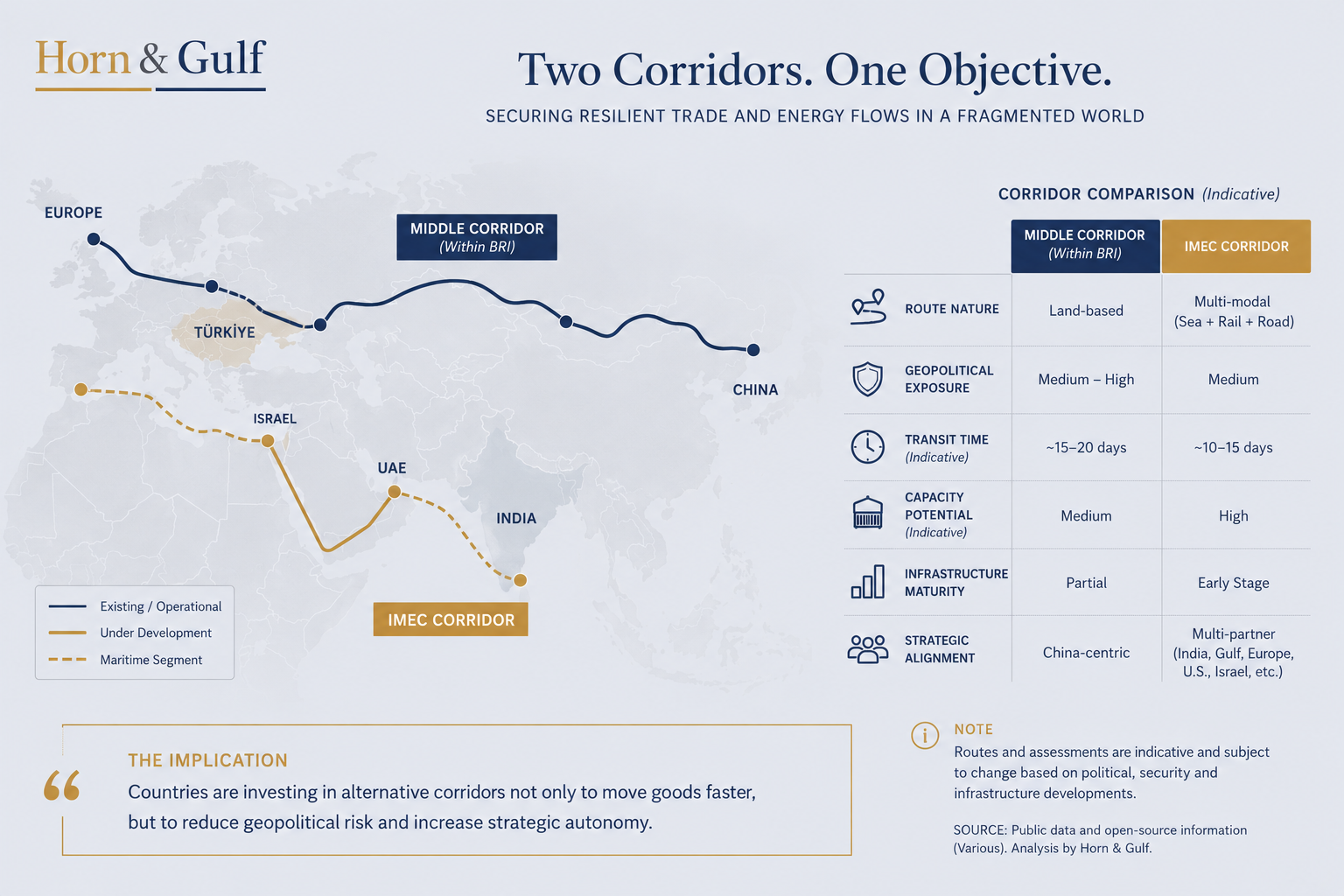
Many of these conditions remain exposed to geopolitical volatility.
The Gaza war demonstrated how quickly regional crises can affect transport planning and broader connectivity discussions. Maritime security conditions across the Red Sea also remain sensitive despite ongoing adaptation efforts inside shipping and energy markets.
At the same time, Türkiye’s approach faces its own structural challenges.
The emerging era of corridor competition increasingly depends not only on military positioning, but also on finance, insurance systems, institutional predictability, arbitration mechanisms and technological integration.
Modern connectivity systems are sustained not only through geography or security capacity, but also through the ability to provide confidence and continuity for trade and capital flows.
That may become one of the defining strategic tests of the coming decade.
The Competition Is Increasingly About Flow Architecture
The longer-term implication is becoming clearer. This is no longer only a traditional territorial competition.
Increasingly, it is a competition over who organizes and secures the movement of trade, energy, data, insurance, capital and supply chains across the wider Afro-Eurasian system. From that perspective, IMEC and Blue Homeland should not necessarily be viewed as entirely opposing realities.
They are, in many ways, competing responses to the same geopolitical transition.
Both reflect the growing importance of resilient connectivity systems in a more fragmented global environment. Both seek to preserve strategic relevance within emerging trade and logistics networks. And both illustrate how states are adapting to an international system where resilience, coordination and supply-chain security are becoming increasingly important alongside efficiency.
That broader transition is likely to shape the Gulf, Eastern Mediterranean and Red Sea system for years to come.