Dubai financial execution layer is no longer a future concept. Citadel’s entry marks a structural shift from capital storage to real-time execution, redefining DIFC’s role in global finance.
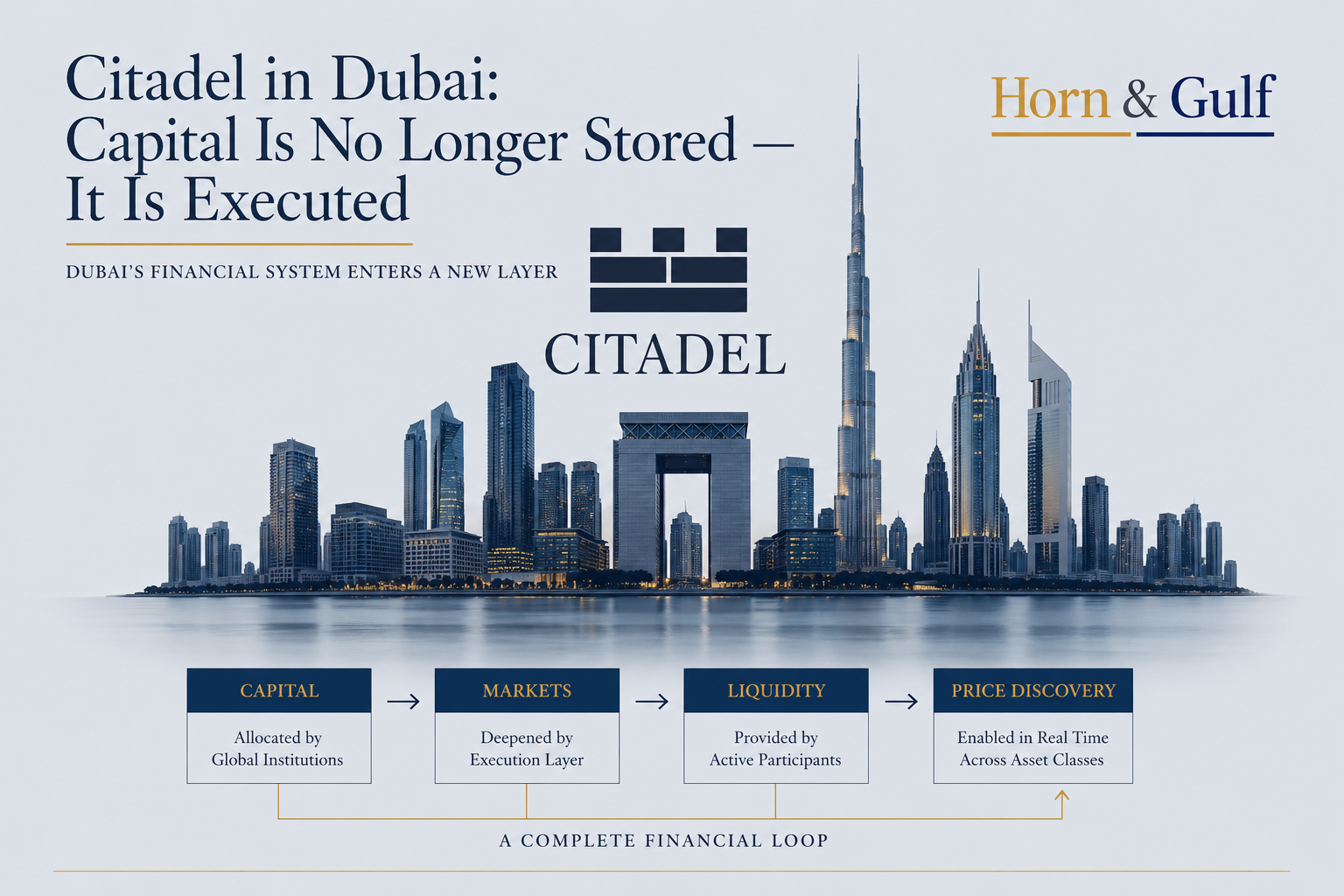
Dubai has spent the past decade attracting capital. That phase is over. With Citadel receiving regulatory approval to operate in Dubai, the system is entering a different stage — one where capital is not just held, but actively deployed, priced, and moved.
This is not an isolated development. It sits on top of a sequence: the expansion of Dubai International Financial Centre, the steady positioning of global asset managers like BlackRock, and a broader shift in how the Gulf is being used in global finance.The signal is clear. The structure is changing. The implications are just beginning.
From Safe Haven to Execution Layer
For years, Dubai’s role in the global system was defined by safety. It was where capital went during uncertainty — a place to park wealth, acquire property, and wait. That model is being replaced.
Citadel does not move for passive exposure. It moves for execution — for environments where trades can be placed, risk can be priced, and liquidity can be accessed without friction. Its presence signals that Dubai is no longer being read as a storage node, but as an operational layer in the global financial system.
This is a structural shift. Capital is not arriving to sit. It is arriving to act.
DIFC Expansion Was Not About Space — It Was About Function
The growth of DIFC has often been interpreted as a real estate story — more offices, more licenses, more firms. That interpretation misses the point.
DIFC’s expansion has been about stacking functions: legal infrastructure, regulatory clarity, capital access, dispute resolution, and increasingly, trading capability. The goal has not been density. It has been completeness.
Citadel’s entry fits precisely into that architecture. It does not add volume. It adds function — specifically, the ability to generate liquidity, compress spreads, and enable continuous price discovery. In system terms, this is the difference between a marketplace and a market.
BlackRock Brings Capital. Citadel Brings Motion.
Previous signals in the Gulf have centered around asset managers — institutions like BlackRock establishing deeper ties, expanding presence, and allocating capital across the region. That phase matters. It builds the base layer: ownership, long-term positioning, institutional confidence.
But asset managers do not move markets in real time. They allocate. They hold. They rebalance. Citadel operates differently. It trades. It arbitrages. It provides liquidity across asset classes and time zones. It turns static capital into moving capital.
Together, they complete a loop:
- Capital is allocated
- Positions are built
- Markets are traded
- Prices are continuously discovered
Dubai is now hosting both sides of that loop.
Liquidity Is Not a Byproduct — It Is the System
There is a tendency to treat liquidity as a secondary effect — something that follows investment. In reality, liquidity is the system. Without it, prices are inefficient, markets are thin, and capital is cautious. With it, execution becomes faster, spreads tighten, and participation deepens.
Citadel’s role globally has been to provide that layer — often invisibly. Its systems sit behind a significant portion of daily market activity, ensuring that buyers and sellers can transact without delay. Bringing that capability into Dubai does not simply increase activity. It changes the quality of the market itself.
A Financial Center Is Defined by What Happens Under Stress
The real test of a financial hub is not growth. It is behavior under pressure. During periods of volatility, capital does not look for branding. It looks for systems that continue to function — where trades clear, liquidity remains, and risk can be managed in real time.
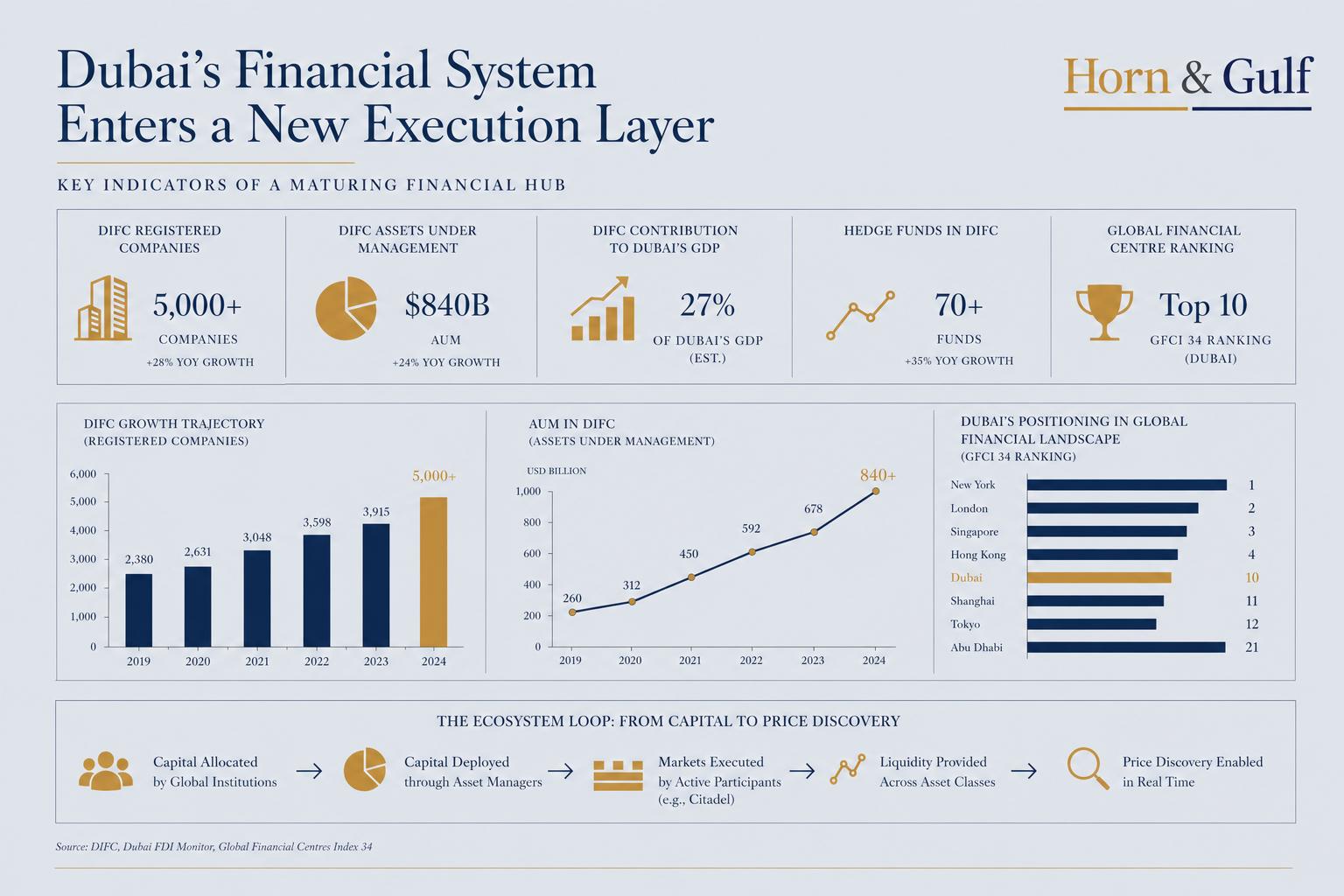
This is where Dubai’s model has been evolving. The city has already positioned itself as politically neutral, operationally open, and structurally resilient. The addition of execution-layer institutions like Citadel strengthens that positioning.
It suggests that in future stress scenarios, Dubai will not only receive capital flows — it will process them.
The Geography of Finance Is Being Redrawn
For decades, the map was stable: New York, London, with auxiliary nodes in Asia. That map is shifting.
Not because the old centers are disappearing, but because the system is becoming multi-nodal. Capital is distributed, risks are diversified, and execution is no longer tied to a single geography.
Dubai’s emergence as a node is not accidental. It sits between time zones, connects multiple capital flows, and operates within a regulatory framework designed for cross-border activity.
Citadel’s move reinforces this position. It anchors Dubai not just as a recipient of flows, but as a processor of them.
Conclusion: Capital Does Not Relocate Randomly — It Reconfigures Systems
What we are seeing is not a wave of company expansions. It is a reconfiguration of how and where financial systems operate.
DIFC expansion provided the structure.
BlackRock-type institutions brought capital.
Citadel brings execution.
Together, they form something more complete — a system where capital can be stored, allocated, and actively deployed within the same environment. The implication is straightforward. Dubai is no longer just part of the global financial system.
It is becoming one of the places where that system runs.