In recent months, narratives suggesting that Dubai is “collapsing” or entering a period of structural decline have circulated widely. These claims tend to emerge quickly, spread rapidly, and rely heavily on short-term signals.
But they do not reflect how Dubai actually functions.
Reading Signals Without Context
Most arguments pointing to a “collapse” are built on selective indicators:
- fluctuations in real estate transactions
- temporary capital outflows
- regional geopolitical tensions
- shifts in investor sentiment
Taken in isolation, these signals can appear alarming. But Dubai is not a system that can be understood through isolated data points. It is an execution-driven environment, designed to absorb volatility rather than be destabilized by it.
A System Built for Movement
Dubai does not operate as a traditional, static economy.
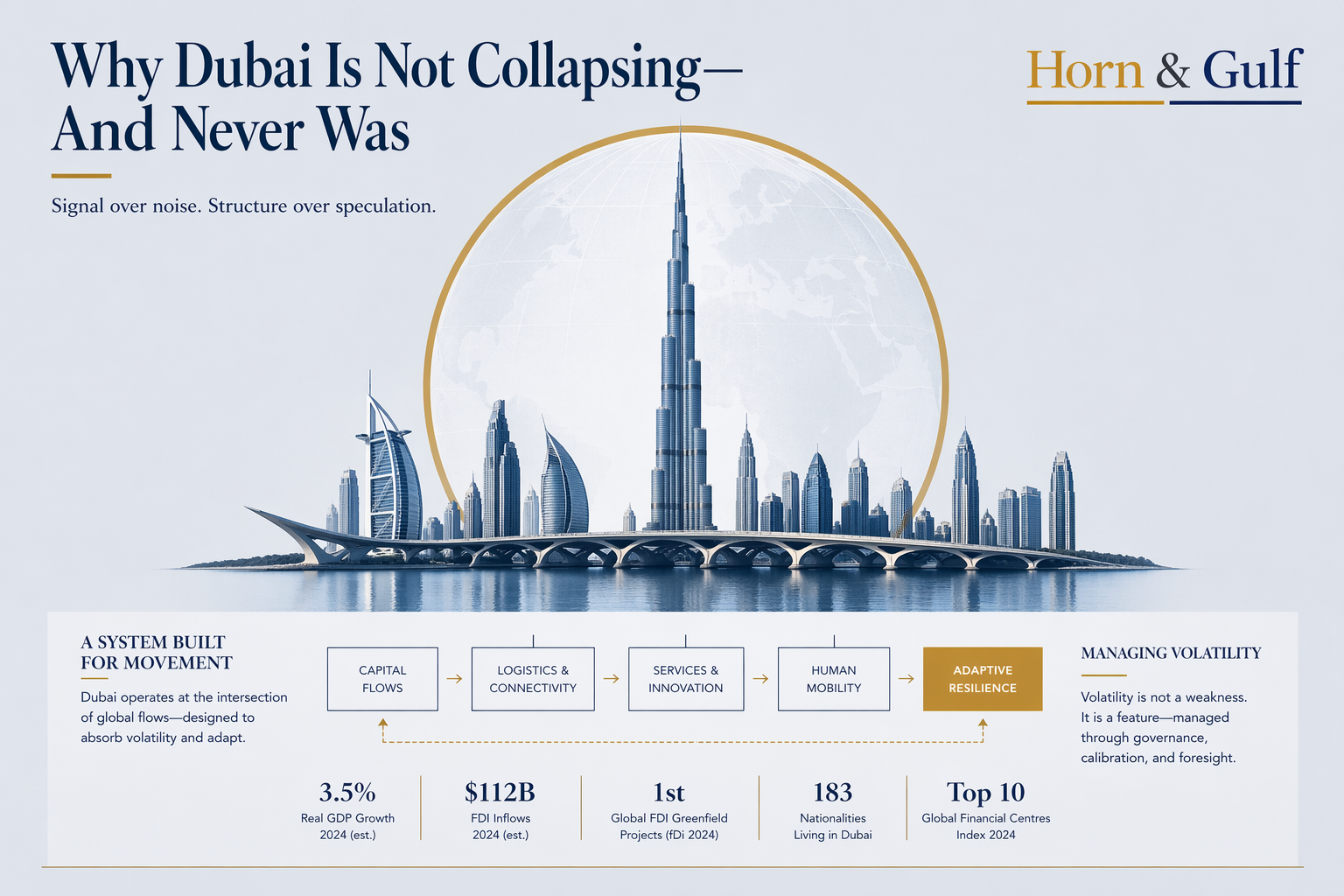
It functions as a node within global flows:
- capital
- logistics
- services
- human mobility
Its strength is not in long-term stability at a micro level, but in its ability to continuously reposition itself within shifting global conditions. This makes short-term fluctuations not a sign of weakness, but a feature of how the system adapts.
The Misreading of Volatility
Periods of slowdown or adjustment are often interpreted as signs of structural fragility. In Dubai’s case, they are more accurately understood as rebalancing phases.
These phases typically involve:
- recalibration of pricing in real estate
- shifts in investor composition
- adjustments in liquidity cycles
- changes in project timelines
None of these are unusual in a high-velocity market. What matters is not whether volatility exists, but whether the system can manage it.
Governance as a Stability Layer
One of the least understood aspects of Dubai is how governance operates beneath the surface. Policy responses are rarely reactive in a visible sense. They are structured, coordinated, and often pre-emptive.
This includes:
- regulatory adjustments
- project pacing
- capital flow management
- infrastructure continuity
The result is not the absence of pressure, but the controlled absorption of it.
The Illusion of Sudden Collapse
The idea that Dubai could “suddenly collapse” assumes a system that is fragile, overextended, and poorly managed. That assumption does not align with how the city has been structured.
Dubai has gone through multiple cycles:
- rapid expansion
- sharp corrections
- external shocks
Each time, the system has adjusted rather than broken. This does not mean it is immune to risk. It means risk is already part of its design.
Where the Real Risks Lie
Dismissing collapse narratives does not mean ignoring risk. The relevant risks are not sudden, dramatic failures.
They are structural and gradual:
- overexposure to specific capital sources
- supply-demand imbalances in certain segments
- global liquidity tightening
- geopolitical spillover effects
These require monitoring, not sensational framing.
Signal Over Noise
Dubai generates strong reactions. It attracts both over-optimism and exaggerated pessimism. Understanding it requires filtering both. The question is not whether Dubai faces pressure. It does.
The question is whether that pressure exceeds the system’s ability to absorb and adapt. So far, it has not.