
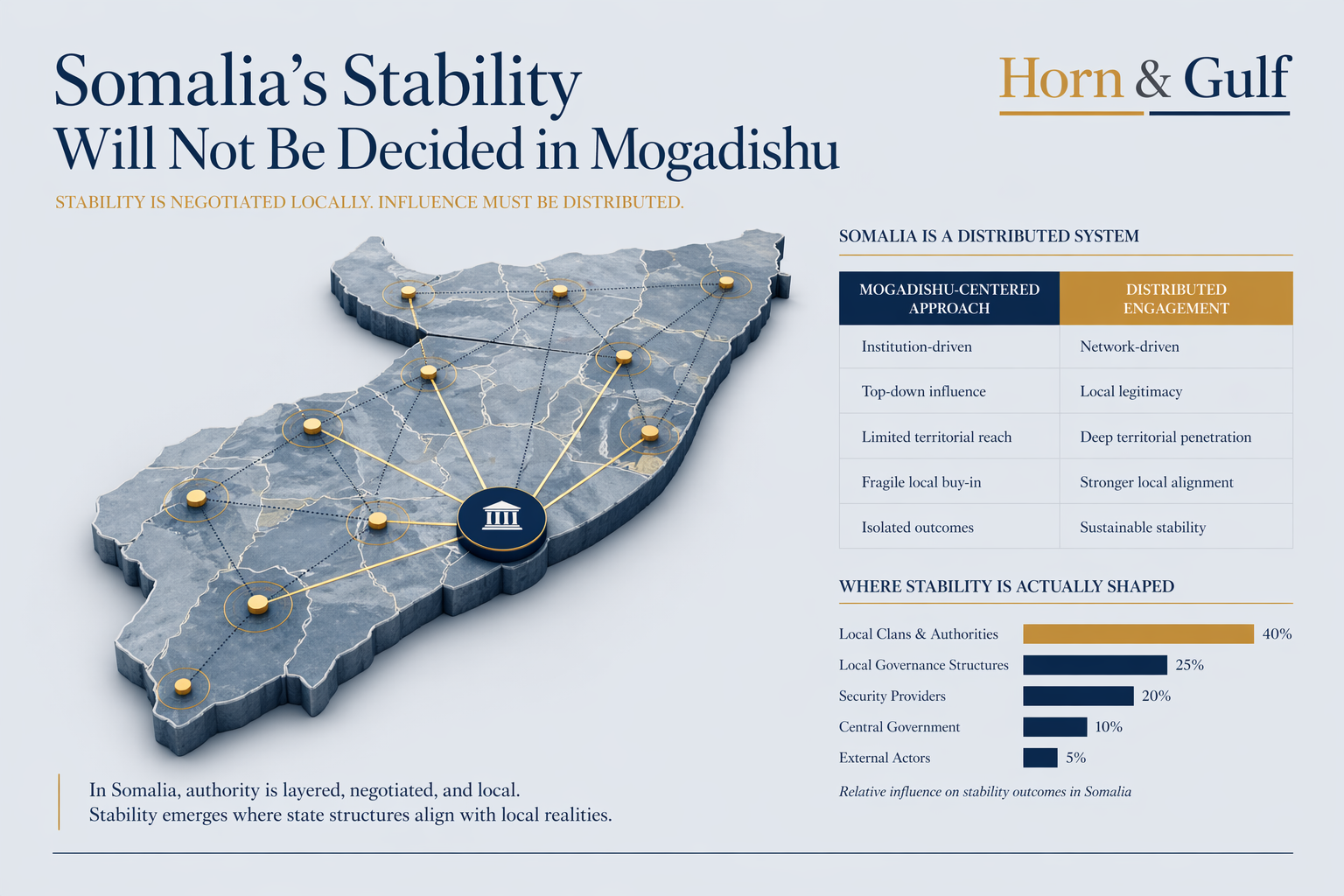
Somalia is often approached through its capital. Diplomatic missions, infrastructure projects, security cooperation — almost all of it is concentrated in Mogadishu. From a state-building perspective, this makes sense.
But Somalia does not function as a capital-centered system. And that is where most external strategies begin to fail.
A State That Does Not Behave Like One
On paper, Somalia has a federal government. In practice, authority is fragmented, layered, and negotiated. Power is not only institutional. It is clan-based, localized, and fluid. This means that stability cannot be produced from the center alone.
Mogadishu can project structure, but it cannot fully control the periphery. And in Somalia, the periphery is not secondary — it is the system itself.
Clans as Political Infrastructure
In many external analyses, clans are treated as a social reality. In Somalia, they are more than that.
They function as:
- security providers
- dispute resolution mechanisms
- economic networks
- political actors
Ignoring them is not a cultural oversight. It is a strategic blind spot. Every region, every corridor, every port is embedded within a clan structure. And those structures determine who governs, who resists, and who cooperates.
Where Al-Shabaab Actually Operates
Al-Shabaab is often framed as a purely ideological or terrorist organization. That is only part of the picture. Its real strength comes from its ability to operate within local dynamics. It does not always confront clans directly. It negotiates, pressures, co-opts, and adapts.
In some areas:
- it embeds itself within existing clan tensions
- in others, it exploits grievances against the central government
- in others, it becomes a parallel authority where the state is absent
This is not random. It is a strategy built on understanding Somalia not as a state, but as a network.
The Limits of a Mogadishu-Centered Approach
Türkiye’s engagement in Somalia has been one of the most visible and sustained external presences. Hospitals, roads, the airport, and the port are not symbolic initiatives. They represent tangible contributions that reinforce the operational capacity of the central government.
At the same time, this engagement has been largely concentrated within Mogadishu and its immediate sphere of influence. This creates a structural asymmetry.
As state capacity expands in the capital, its translation into broader territorial influence remains uneven.
In a system where authority is distributed and negotiated, this concentration may not automatically extend into the local layers where stability is actually shaped.
Over time, such an approach can face the risk of being perceived as selective in its reach, potentially aligning more closely with specific administrative or political layers, rather than the full spectrum of local actors.
This is not a question of intent, but of system design. Because in Somalia, influence is not defined solely by infrastructure or institutional strength, but by how effectively engagement intersects with local structures of legitimacy.
Why Micro-Diplomacy Matters
If Somalia is not governed only from the center, then engagement cannot be centered only on the capital. What is required is not just state-to-state diplomacy, but micro-level engagement.
This includes:
- understanding clan alignments and rivalries
- identifying local power brokers
- working with community-level authority structures
- recognizing where legitimacy actually exists
This is not an alternative to state-building. It is what makes state-building possible. Without it, infrastructure risks becoming isolated islands of control, rather than part of a connected system.
Stability Is a Distributed Outcome
Somalia will not stabilize because Mogadishu becomes stronger alone.
It will stabilize when:
- local structures align with central authority
- security is not imposed but negotiated
- external actors understand where real influence lies
This is slower. It is more complex. But it is also more real.
Signal Over Noise
The dominant narrative focuses on institutions, elections, and capital-based governance. But Somalia does not break down or stabilize at that level. It does so at the level of clans, corridors, and local agreements. Ignoring this produces clean strategies on paper — and fragile outcomes on the ground.
Understanding it changes how stability itself is defined.