Gulf security divergence is becoming more visible as regional states respond differently to the same escalation environment. Recent tensions surrounding reported Gulf-Iran confrontation dynamics suggest that Saudi Arabia and the UAE may increasingly prioritize different forms of deterrence, stability and systemic risk management.
The issue is not necessarily alliance breakdown. Instead, it reflects diverging escalation doctrines inside an increasingly layered Gulf security architecture.
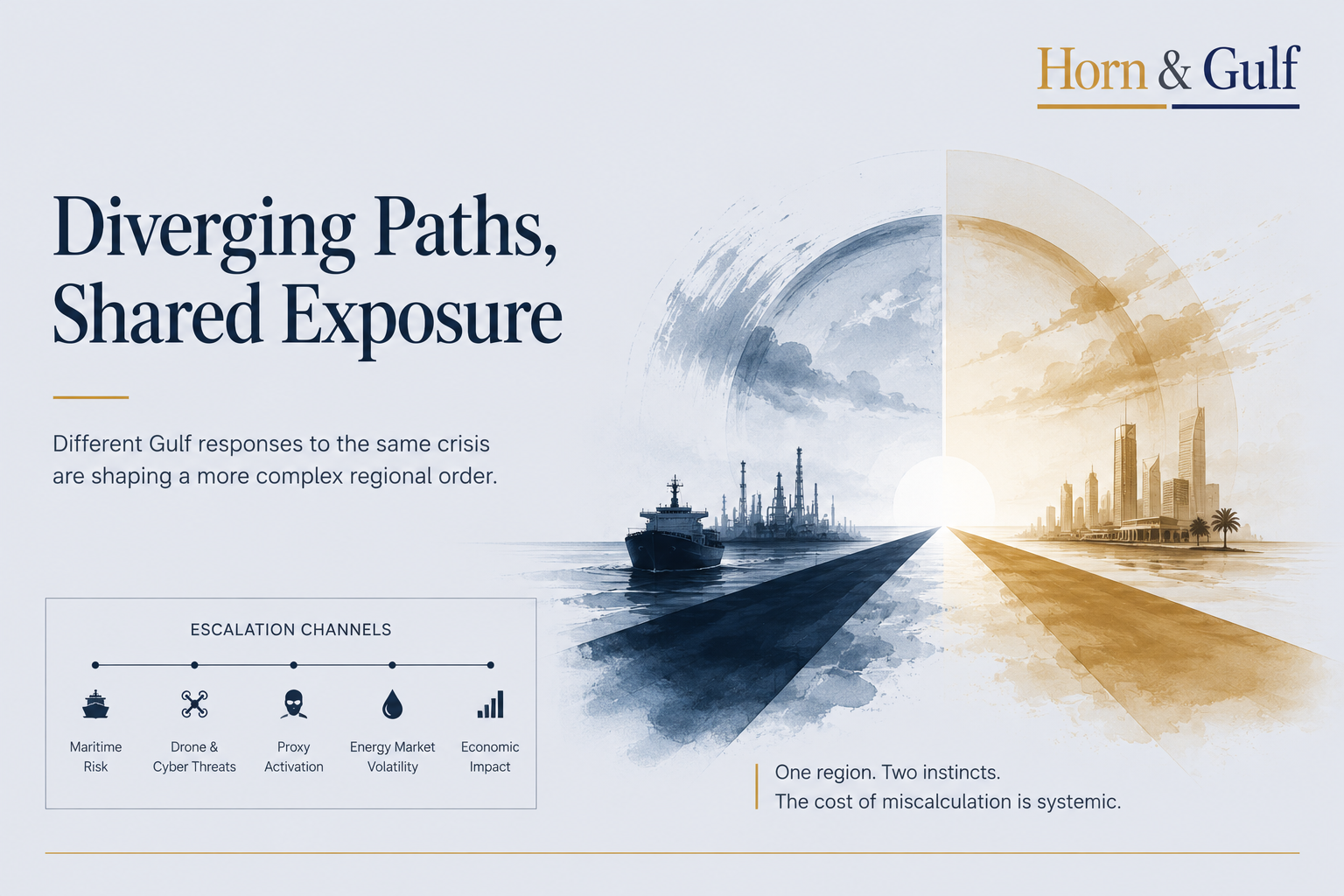
Different Gulf Responses to the Same Crisis
The most important signal emerging from the recent Gulf-Iran escalation may not be the reported strikes themselves. Instead, it may be the appearance of two different Gulf approaches to regional security management.
Several reports circulating across diplomatic and security circles suggest that Emirati-linked operations targeted Iranian military and energy-related infrastructure connected to the Hormuz system. These sites reportedly included facilities associated with Bandar Abbas, Qeshm and nearby strategic zones.
However, Abu Dhabi has not publicly confirmed these operations. That distinction matters. Much of the current information environment still reflects selective disclosures, wartime signaling and rapidly amplified social-media narratives.
Some online claims have gone much further. They portray the episode as evidence of a direct Saudi-Emirati confrontation over Iran policy. At this stage, those claims appear overstated. No verified evidence shows that Riyadh publicly released operational target lists or openly attempted to politically isolate the UAE.
Strategic Priorities Are Not Always Identical
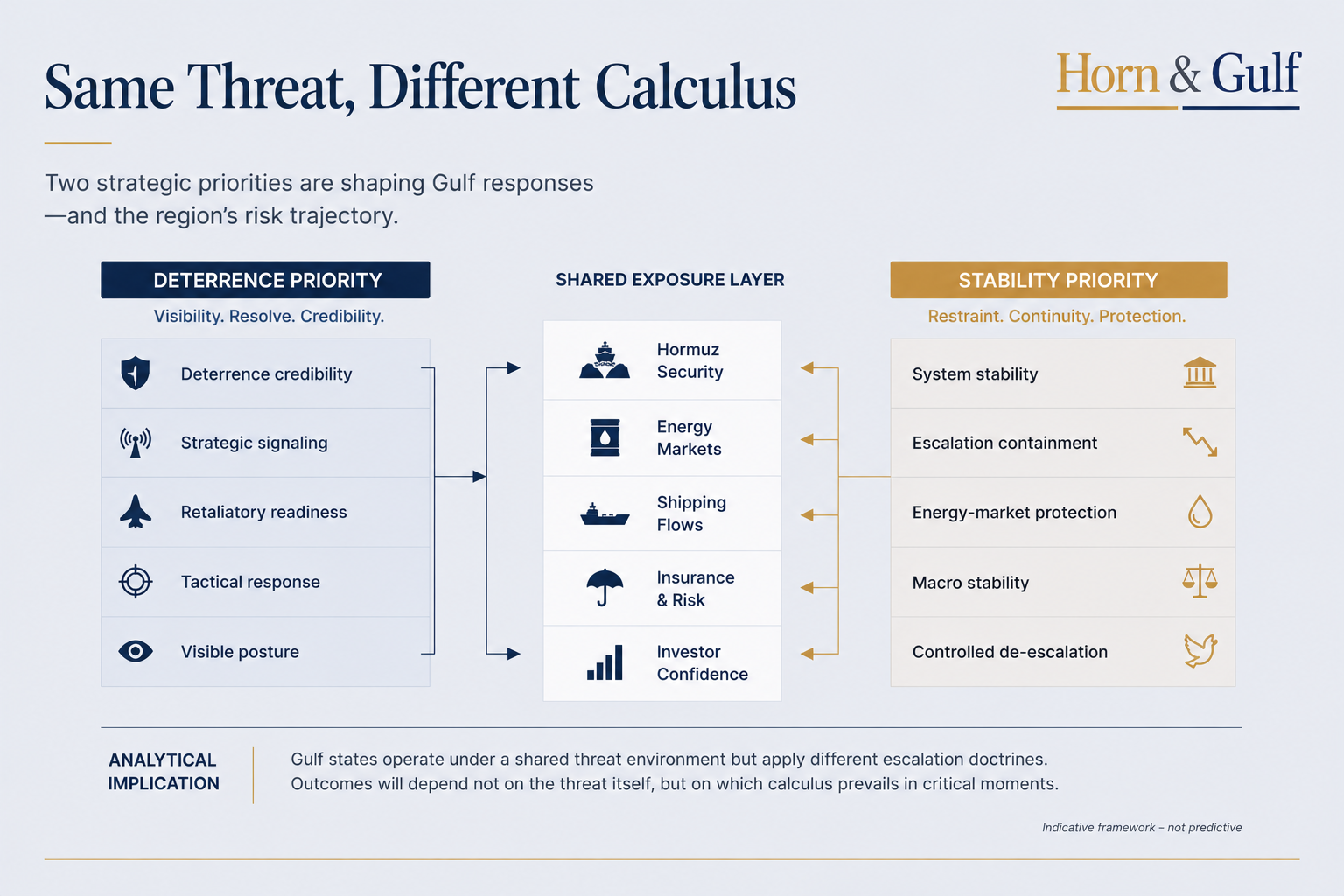
A narrower and more plausible interpretation is emerging. Gulf capitals may share the same threat perception while maintaining different escalation thresholds.
This distinction is less about alliance breakdown and more about strategic prioritization.
For Saudi Arabia, regional stability increasingly overlaps with macroeconomic continuity. Vision 2030 financing requirements, oil-market stability, investor confidence and infrastructure transformation all depend on preventing uncontrolled regional escalation. From this perspective, the primary danger is not only military confrontation itself. The broader concern is the destabilization of the Gulf economic system.
The UAE faces a somewhat different exposure profile. Its strategic model depends heavily on ports, logistics corridors, aviation networks, financial connectivity and international business confidence. Under such conditions, prolonged vulnerability without visible deterrence can also create strategic costs.
Neither posture should automatically be interpreted as contradictory. Both approaches can emerge from the same threat environment while producing different operational instincts.
A More Layered Gulf Security Architecture
This distinction matters because the Gulf security architecture is becoming more layered than it was a decade ago.
The traditional assumption that Gulf states will respond identically to regional threats is becoming harder to sustain. Coordination remains substantial. However, coordination no longer necessarily implies identical risk calculations, escalation tolerance or strategic sequencing.
The immediate issue is escalation management.
If Iranian strategic infrastructure is targeted — whether directly or indirectly — responses may not remain symmetrical. The greater regional danger could emerge through maritime pressure, shipping disruption, cyber activity, selective proxy activation, aviation insecurity or energy-market volatility.
That distinction is especially important for the Hormuz system.
The Strait’s vulnerability does not depend solely on physical closure scenarios. Insurance repricing, tanker-risk recalculation, rerouting behavior, shipping hesitation and energy-market psychology can generate economic effects long before any formal disruption occurs.
Systemic Continuity vs Deterrence Credibility
This is where the broader Gulf response becomes strategically relevant.
Some regional actors appear increasingly focused on preserving systemic continuity. Their priority is protecting energy-market stability, maintaining investor confidence and avoiding uncontrolled military spirals.
Others appear more focused on reinforcing deterrence credibility under conditions of sustained regional pressure. These approaches are not mutually exclusive. Still, they do not always produce identical tactical preferences.
In the medium term, this may reinforce a pattern already visible across the Gulf and Red Sea systems. States are simultaneously coordinating, hedging and selectively differentiating their security behavior.
That does not necessarily indicate fragmentation. Instead, it may reflect a maturing regional order in which Gulf states are becoming more operationally autonomous while remaining strategically interconnected.
The Risk of Over interpretation
There is also a meaningful counterargument.
The current episode may ultimately prove more temporary than structural. Wartime reporting environments often produce exaggerated interpretations, selective leaks and narrative amplification. Some dramatic online claims may reflect information warfare dynamics or audience-driven escalation narratives rather than durable geopolitical transformation.
Markets and regional states may also prove more resilient than current commentary assumes.
Several critical elements remain unclear. These include the precise scale of the reported operations, the degree of external coordination involved, the exact diplomatic exchanges between regional capitals and whether current divergences represent temporary tactical differences or the beginning of a longer-term doctrinal adjustment.
Those uncertainties matter.
A Gradual Strategic Differentiation
Still, the broader signal should not be ignored.
The Gulf’s evolving security environment is increasingly shaped not only by shared threats, but also by different calculations regarding escalation management, deterrence credibility, economic continuity and systemic risk tolerance.
The region is not necessarily moving toward rupture.
However, it may be moving toward a more differentiated security architecture — one in which strategic alignment remains intact while operational approaches gradually become less uniform.