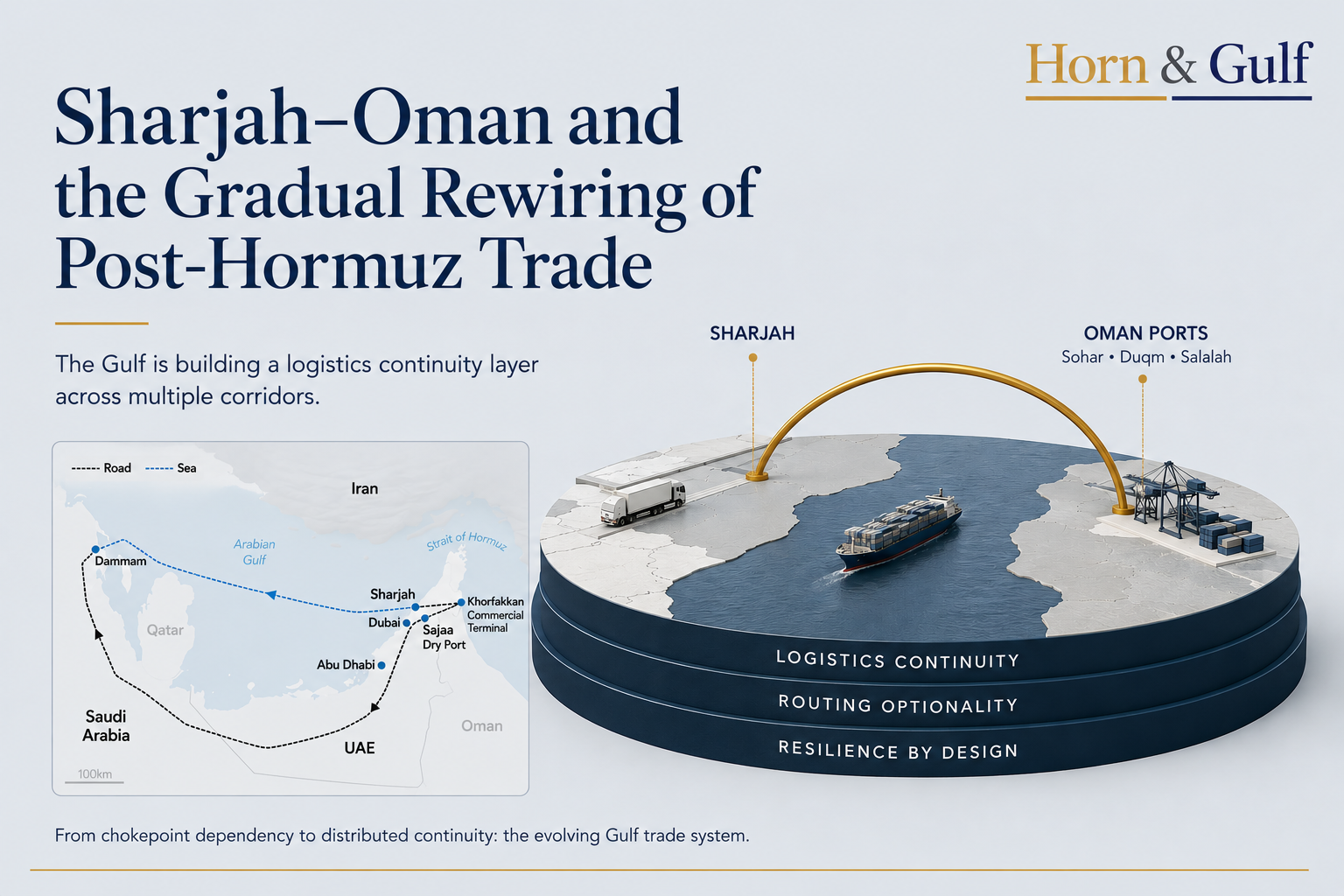
The emerging Gulf logistics corridor between Sharjah and Oman reflects a broader transformation in regional trade architecture. As Hormuz-related risk remains embedded in regional planning assumptions, Gulf states are gradually building more diversified continuity systems across ports, land corridors and maritime networks.
What appears at first to be a customs and logistics initiative may ultimately signal a larger shift in how the Gulf manages trade resilience under geopolitical pressure.
The Gulf Is Building a Logistics Continuity Layer
The visible signal appeared technical rather than geopolitical.
Sharjah announced a logistics corridor connecting the emirate with Oman’s ports of Sohar, Duqm and Salalah. On the surface, the initiative was presented as a trade facilitation mechanism designed to improve cargo movement, customs coordination and regional connectivity.
But beneath the administrative language sits a broader regional trend. The Gulf appears to be gradually strengthening how trade continues under chokepoint pressure.
This is no longer simply about ports competing for cargo volume. Increasingly, it is about states building greater redundancy into regional circulation systems.
In practical terms, the Sharjah–Oman corridor reflects a wider transition: from highly concentrated maritime dependency toward more distributed continuity management.
When the Gulf Did Not Stop — It Adapted
One of the most notable aspects of the recent Hormuz tensions was not the disruption itself, but the speed of adaptation that followed.
As pressure around traditional maritime routes intensified, energy exports and container activity increasingly shifted toward the UAE’s eastern coastline. Trade flows did not stop. They adjusted.
That distinction matters.
For years, much of the Gulf’s logistics architecture remained centered around a relatively small number of dominant nodes and highly concentrated shipping routes. The emerging system increasingly appears more flexible.
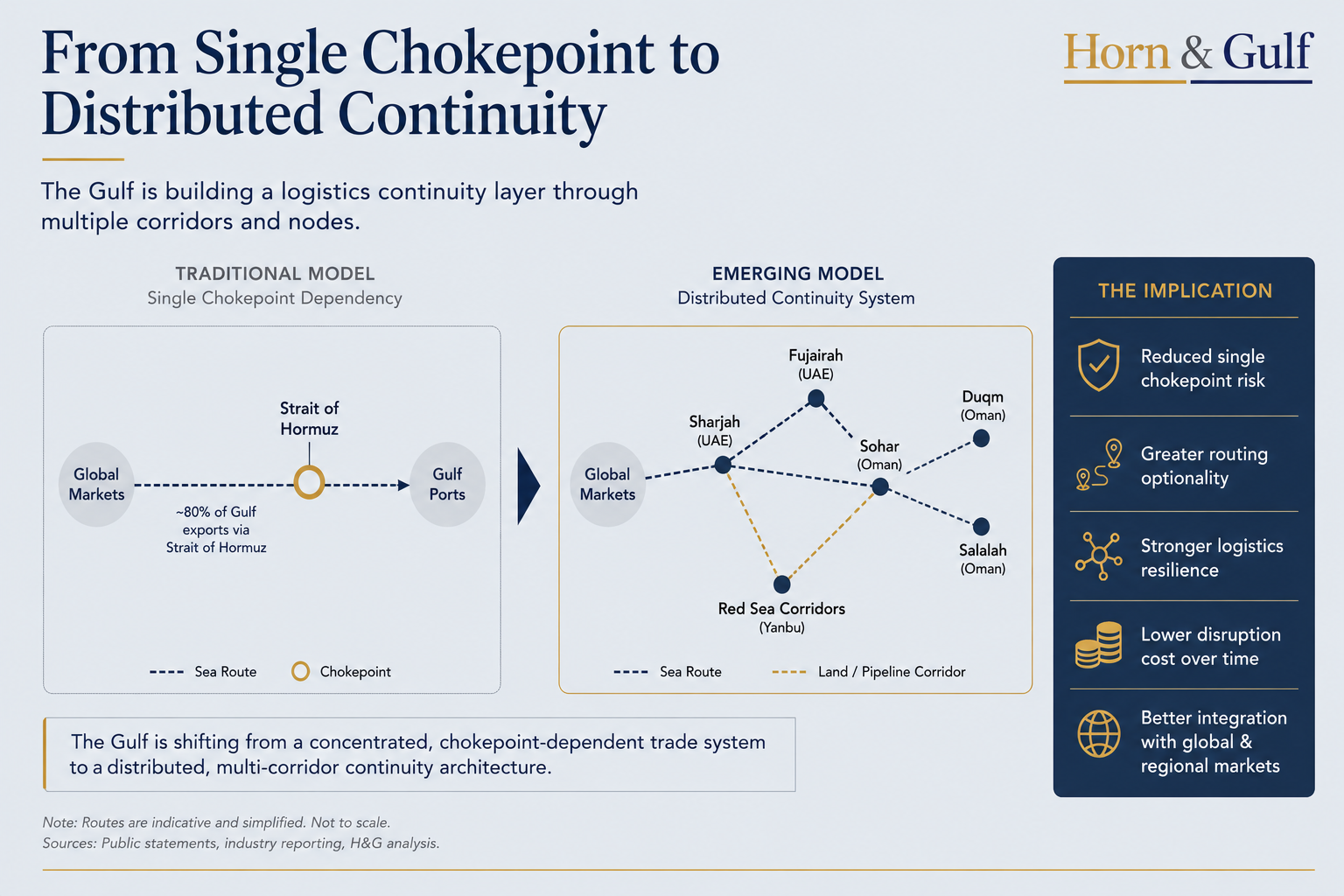
The region is gradually operating through a broader network structure:
- Fujairah as an eastern energy outlet
- Sohar as a supplementary logistics platform
- Duqm as long-term industrial depth
- Salalah as an Indian Ocean connector
- Red Sea corridors as western continuity channels
This is not decentralization in the political sense. It is diversification in the operational sense. The Gulf is building optionality into its trade infrastructure.
Sohar and the Expansion of Regional Logistics Capacity
Sohar’s growing importance remains underappreciated. Traditionally viewed as an Omani industrial port, Sohar is increasingly functioning as a wider logistics support node within the Gulf system.
That role becomes especially important during periods of maritime uncertainty.
As insurers reassess regional exposure and shipping operators adjust route calculations, ports outside the immediate Strait of Hormuz bottleneck naturally gain additional strategic value. Recent shipping patterns suggest increasing operational interest in these alternative corridors.
The significance is not merely logistical.
Shipping activity can sometimes provide early indications of how private-sector actors are pricing geopolitical risk, even before policy language fully reflects those shifts.
Infrastructure strategy, shipping behavior and insurance calculations increasingly interact within the same system. That dynamic is becoming more visible across the Gulf.
The Strategic Importance of Continuity
The most important effects of geopolitical instability do not always emerge through dramatic headlines alone. They often emerge through operational caution.
Changes in insurance pricing, additional surcharges, selective coverage adjustments and operational slowdowns can create pressure on regional trade systems even when flows continue.
This is where Gulf geopolitics increasingly intersects with capital behavior.
Modern maritime systems are no longer governed solely by naval presence. They are also shaped by layered confidence mechanisms:
- insurance availability
- shipping predictability
- customs efficiency
- rerouting capacity
- infrastructure redundancy
- delivery reliability
The strategic issue is therefore no longer whether disruption can occur. Increasingly, disruption is being factored into planning assumptions.
The more important question is whether flows can continue despite periods of instability. That distinction is becoming increasingly important for regional planning.
It also explains why logistics corridors are now being treated as strategic infrastructure alongside pipelines, ports and energy terminals.
The Return of the Land Corridor
One of the more notable developments has been the gradual return of land-based trade corridors across the Arabian Peninsula.
In many ways, the region is rediscovering older commercial patterns through modern infrastructure systems.
Historically, Gulf commerce depended on caravan routes crossing the peninsula long before the rise of tanker-centered maritime economies. Today, parts of that logic are re-emerging in updated form through highways, bonded logistics systems and multimodal transport networks.
The future Gulf trade architecture increasingly appears diversified rather than purely maritime:
- ports
- bonded logistics zones
- highways
- customs corridors
- rail integration
- pipelines
- dry ports
Together, these elements are gradually forming a more integrated regional resilience system. This does not appear to be a temporary adjustment. Increasingly, it resembles a longer-term strategic evolution.
Fujairah and the Geography of Resilience
The evolution of Fujairah illustrates this transition clearly.
For years, Fujairah was often described simply as an alternative export port. Today, that description appears increasingly incomplete.
The UAE continues to expand east-coast export infrastructure and strengthen bypass capacity outside the Strait of Hormuz. In strategic terms, Fujairah is gradually evolving from a backup facility into a larger continuity platform. That evolution matters because it changes the geography of Gulf resilience.
The region appears to be gradually reducing reliance on any single maritime chokepoint within its broader export architecture. Instead, it is developing layered continuity options across multiple corridors.
Hormuz and the Red Sea Are Increasingly Connected
Perhaps the most important structural implication is the growing integration between Hormuz strategy and Red Sea strategy.
As Gulf states develop eastern continuity systems through Oman and Fujairah, western corridors linked to the Red Sea are simultaneously becoming more important.
The emerging regional structure increasingly looks like this:
- Hormuz as a high-sensitivity maritime gate
- Fujairah as an eastern bypass outlet
- Oman as a logistics buffer layer
- Yanbu as a western export release point
- The Red Sea as a continuity corridor rather than simply a shipping route
This is a broader geopolitical transition often hidden beneath daily headlines. The Gulf and the Red Sea are no longer functioning as entirely separate theatres. Increasingly, they are becoming interconnected parts of a wider flow-management system.
India and the Indian Ocean Dimension
Another underpriced dimension is India.
The growing role of Omani ports within India–Gulf trade suggests that the corridor logic extends beyond GCC economics alone.
As global supply chains become more fragmented and geopolitical risk remains elevated, Oman’s geography gains value not because it replaces Gulf infrastructure, but because it supports it.
That distinction matters.
The Gulf’s future resilience may depend less on eliminating chokepoint risk entirely and more on surrounding chokepoints with enough alternative pathways to keep markets functioning during periods of stress.
From Oil Geography to Flow Management
The deeper transformation underway in the Gulf is ultimately conceptual as much as logistical.
The region appears to be moving gradually away from a highly centralized maritime export structure toward a more distributed resilience model.
That shift carries important long-term implications. For decades, Gulf influence was primarily associated with hydrocarbon production capacity. Today, another capability is becoming increasingly important: the ability to preserve circulation and continuity during geopolitical turbulence.
Energy still matters. Ports still matter. Maritime routes still matter. But increasingly, the region’s strategic value also lies in its ability to maintain operational continuity under pressure.
That is why the Sharjah–Oman corridor matters beyond customs coordination or cargo movement alone.
It offers an early indication of how the Gulf may continue adapting its trade architecture in a more uncertain geopolitical environment.
And perhaps most importantly, it reflects a broader regional transition already underway: The Gulf is no longer focused only on the movement of energy. Increasingly, it is focused on the continuity of flow itself.