The recent normalization of transit through the Strait of Hormuz has been widely interpreted as a return to stability. Tankers are moving, insurance pressure has eased at the margin, and the immediate sense of disruption has receded. On the surface, the system appears to be functioning again. The assumption follows naturally: the risk has passed, and the corridor is stabilizing.
That conclusion is too quick.
What we are seeing is not a restoration of the old system, but the continuation of a new one — a system in which flow persists, but certainty does not. The passage through Hormuz may be open, but it is no longer neutral. It is conditioned, monitored, and implicitly negotiated. The difference matters, because in this environment, movement alone is not the measure of stability. It is the terms under which that movement takes place.
The Strait of Hormuz has always been a chokepoint in geographic terms, but it is now something more consequential: a point of exposure within a fragmented system. Traffic can resume without friction disappearing. Ships can pass while risk remains embedded in pricing, routing decisions, and operational planning. The corridor functions, but under tension. It is not secured in the traditional sense; it is tolerated within a balance that can shift.
This is where the reading must change.
The focus on whether ships can pass through Hormuz misses the more important question of what happens after they do. A functioning chokepoint is not the same as a functioning system. Movement through a narrow passage is only one part of a larger chain that determines whether trade is efficient, reliable, and ultimately viable. That chain no longer depends on geography alone. It depends on nodes.
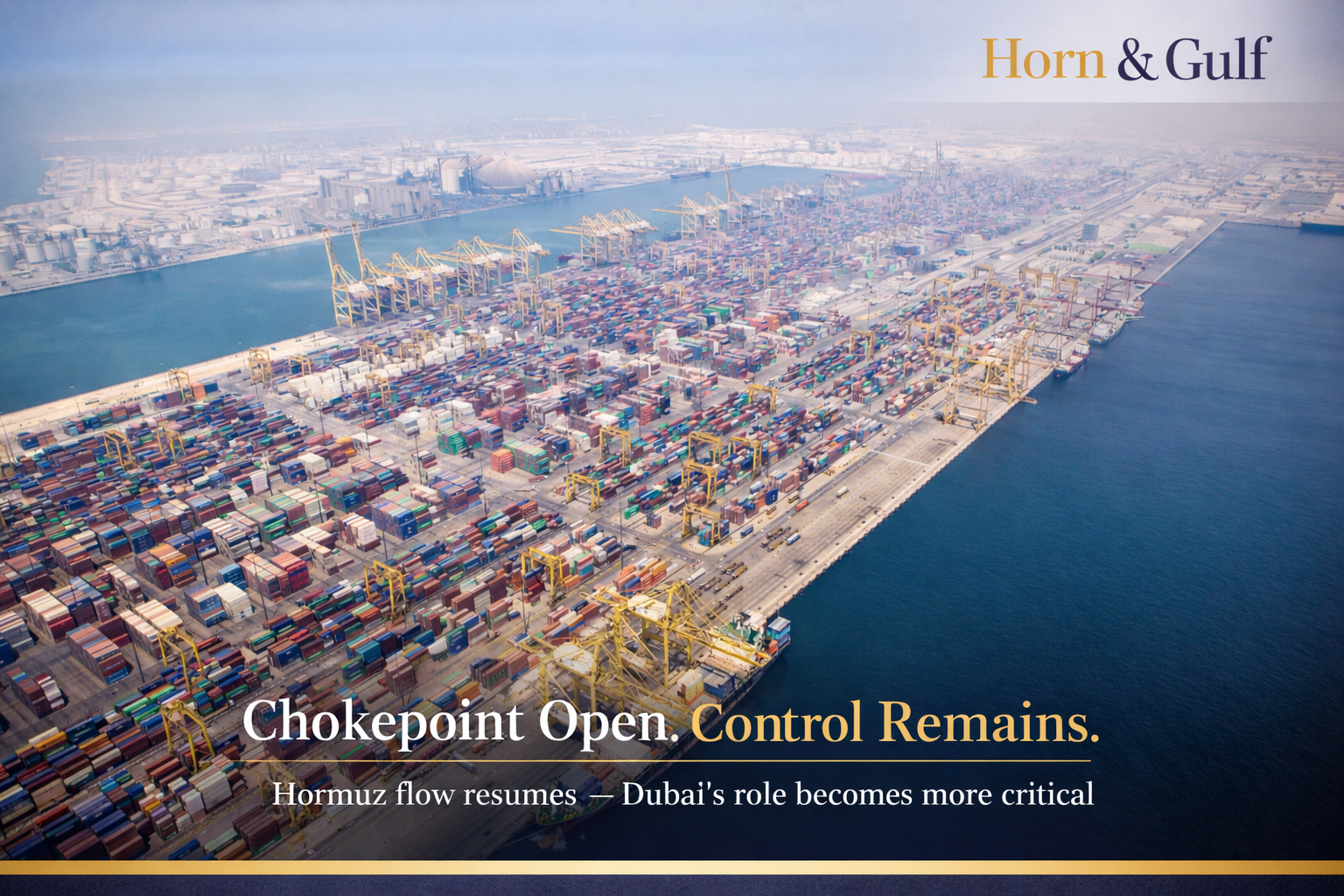
Dubai’s maritime positioning needs to be read in that context. The recent statement by the Dubai Ports Authority, outlining its capacity to provide fully integrated, round-the-clock maritime services, does not introduce anything new at the level of capability. Dubai has long been able to offer bunkering, provisioning, crew changes, and operational support with high efficiency. What is new is the environment in which these capabilities are being articulated.
The emphasis on integration, continuity, and responsiveness is not incidental. It reflects an understanding that in a system where routes are exposed, value shifts to the points that can absorb that exposure and convert it into reliability. A vessel entering Dubai’s operational ecosystem does not simply receive services. It enters a controlled environment where uncertainty is reduced, time is compressed, and decisions become easier. That is the real product.
The distinction between a passage and a node becomes critical here. Hormuz enables flow, but it does not manage it. It cannot provide redundancy, coordination, or recovery from disruption. It is a fixed constraint — essential, but passive. Dubai, by contrast, operates as an active layer within the system. It takes the output of a volatile corridor and transforms it into something predictable. In a fragmented trade environment, that transformation carries strategic weight.
The current global context reinforces this shift. Supply chains are no longer optimized solely for efficiency. The last few years have forced a re-evaluation of how risk is distributed across routes, regions, and operational dependencies. Disruptions in the Red Sea, fluctuating security conditions, and the politicization of maritime space have all contributed to a new baseline: trade continues, but under persistent uncertainty. In that environment, reliability becomes the primary currency.
Companies do not simply look for the shortest route or the lowest cost. They look for the configuration that minimizes disruption over time. This pushes attention away from linear routes and toward system architecture. Ports, logistics hubs, and service layers become more than intermediaries. They become stabilizers.
Dubai fits this role with precision.
Its model does not rely on controlling chokepoints or projecting force across maritime corridors. It operates through consistency. The ability to offer uninterrupted service, integrate multiple operational needs within a single framework, and reduce friction at scale creates a form of control that is less visible but more durable. It is not about blocking or directing flows, but about making certain flows easier to sustain than others.
Over time, that creates dependency. The normalization of Hormuz traffic, when seen alongside this model, reveals a deeper pattern. Stability at the chokepoint level does not eliminate the need for control elsewhere. In fact, it increases it. When passage becomes possible but not guaranteed, actors seek environments that compensate for that uncertainty. They move toward nodes that can absorb volatility without transmitting it further down the chain.
This is where Dubai’s positioning becomes structural rather than operational. It is not reacting to disruption. It is operating within a system that now assumes disruption as a constant. The emphasis on integrated services is therefore not a marketing statement. It is a statement of role. Dubai is defining itself not as a point along a route, but as a layer that makes the route usable under conditions of uncertainty.
That distinction marks a broader shift in how maritime power is exercised. Control is no longer anchored solely in geography. It is distributed across systems that manage flow after geography has done its part. Chokepoints still matter, but they do not determine outcomes on their own. What happens before and after them carries equal weight, if not more.
The Strait of Hormuz remains critical. Its reopening to normal traffic is significant. But it does not restore the conditions that once made global trade predictable. It simply confirms that movement can continue within a system that has fundamentally changed.
The question is no longer whether goods can pass. It is whether they can move through a system that is stable enough to rely on. Dubai’s answer to that question is already in place.