The Red Sea is increasingly being described as a “crisis zone.” It’s a convenient label, but it doesn’t really explain what’s happening. What we are seeing today is not a temporary disruption. It’s part of a deeper structure that has been forming for years.
Beyond the Headlines
Most discussions focus on individual events: attacks on commercial vessels, disruptions in shipping lanes, regional tensions spilling into the sea. But these are not isolated incidents. They are connected.
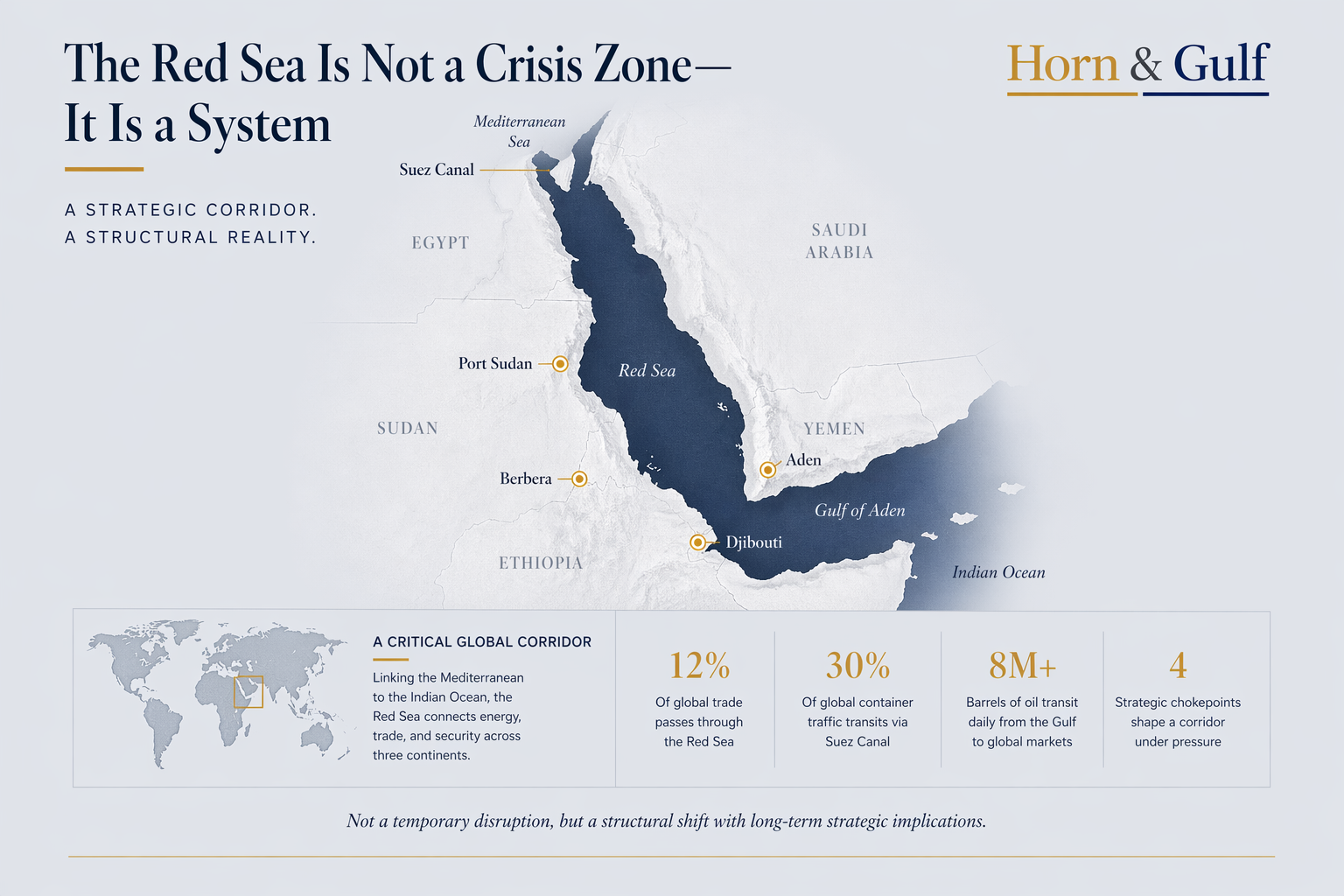
The Red Sea is not just a place where things go wrong. It is a corridor where global trade, regional politics, and security interests intersect. It links the Suez Canal to the Indian Ocean. It carries Gulf energy toward Europe. It connects African ports to global markets.
When something happens here, it doesn’t stay local.
Ports, Power, and Presence
Control in the Red Sea is not only about land. It’s about access, logistics, and presence. Places like Aden, Berbera, Djibouti, and Port Sudan are not just ports. They are strategic points where influence is built and projected.
Different actors — states and non-state groups — are not simply reacting to events. They are positioning themselves within this structure. And that positioning is long-term.
The Problem with the “Crisis” Narrative
Calling the Red Sea a “crisis zone” creates the impression that things will go back to normal. But there isn’t a clear “normal” to return to. What we are seeing instead is a more permanent condition: overlapping authorities, competing security structures, external powers operating in the same space,local actors affecting global systems.
This is not a short-term crisis. It’s a new phase.
Why It Matters
A significant share of global trade passes through this corridor. Energy flows, supply chains, and insurance costs are all tied to what happens here. If we treat this as a series of isolated crises, we miss the bigger picture. The real issue is structural instability, not occasional disruption. And that changes how risk should be understood.
Signal Over Noise
There is a lot of noise around the Red Sea right now. To make sense of it, you have to step back from individual events
and look at how the system itself is evolving.
The Red Sea is not falling into chaos. It is being reshaped. And whatever form it takes next will matter far beyond the region itself.