Saudi nuclear enrichment is becoming a major strategic issue in U.S. Gulf policy. The debate no longer revolves only around civilian nuclear energy. Increasingly, it reflects how Washington balances non-proliferation principles with long-term strategic relationships in the Gulf.
A Debate Larger Than Nuclear Energy
The debate over whether Saudi Arabia should be permitted to enrich uranium is no longer only a technical discussion about civilian nuclear energy. Increasingly, it has become a broader test of how Washington balances non-proliferation principles with its long-term strategic relationships in the Gulf.
Following question: ” if the United States insists on strict enrichment restrictions for Iran, should Saudi Arabia operate under a different framework? is touching on a sensitive policy issue.
A system perceived as applying differently to partners and adversaries risks looking less like a universal standard and more like a politically differentiated one.
That tension now sits at the centre of the debate.
The UAE Model and Saudi Flexibility
Saudi Arabia and Iran occupy very different positions in U.S. regional strategy. Riyadh remains a longstanding security partner, a major energy producer, and an increasingly important industrial and technology actor. Tehran, meanwhile, continues to face deep strategic mistrust from Washington and its regional allies.
Still, nuclear policy is shaped not only by present relationships. It is also shaped by long-term capability management and future strategic uncertainty.
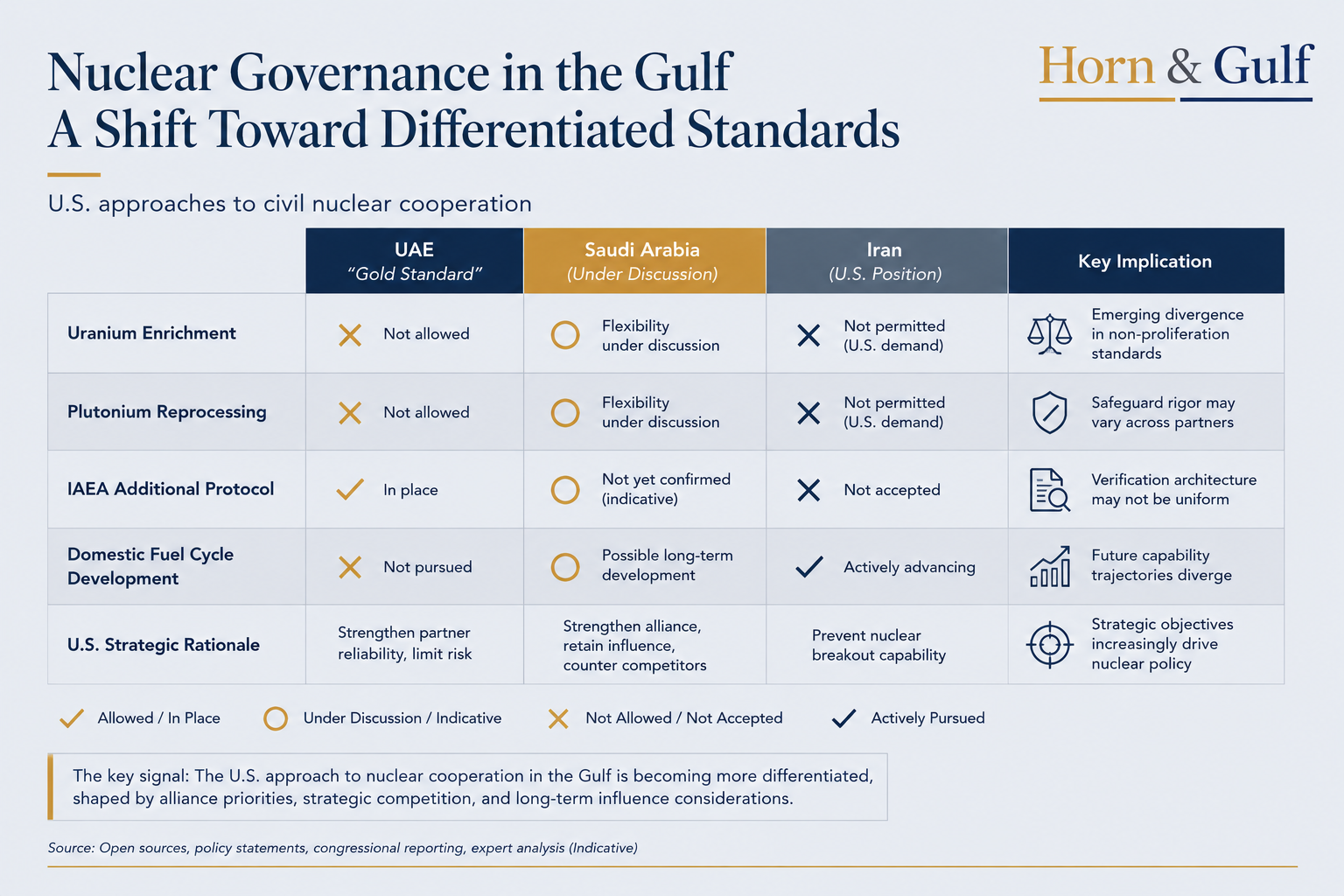
For years, the United States tried to maintain a relatively clear framework in the Gulf. The UAE’s Barakah nuclear programme became the region’s best-known example of the so-called “gold standard” approach: civilian nuclear development without domestic uranium enrichment or plutonium reprocessing.
Saudi Arabia has signaled for years that it prefers greater long-term flexibility than the UAE model allows. Saudi officials have repeatedly discussed uranium resources, energy diversification, and the development of a broader domestic nuclear-industrial ecosystem.
That should not automatically be interpreted as evidence of an imminent enrichment programme. Current public evidence does not support that conclusion.
A more measured reading suggests that Riyadh wants to preserve future policy flexibility as part of a wider industrial and strategic transition.
Why Washington Is Reassessing the Issue
In Gulf strategic planning, long-term flexibility carries considerable value.
For Saudi Arabia, nuclear development forms part of a broader economic transformation agenda tied to industrial diversification, energy transition, scientific capacity, and technological sovereignty.
Washington faces a different calculation. The United States wants to preserve long-term influence over emerging Gulf infrastructure systems while preventing strategic competitors from gaining deeper access to the region.
If Washington remains too restrictive, Gulf states may increasingly explore alternative suppliers and partnerships. China, Russia, France, and South Korea all remain potential participants in future regional nuclear projects.
This is one reason the discussion now extends beyond enrichment itself.
The Infrastructure Dimension
Civil nuclear cooperation creates relationships that can last for decades. Reactor systems require regulatory coordination, engineering support, fuel management, cybersecurity integration, insurance structures, inspection regimes, and sustained political trust.
States that help build Gulf nuclear infrastructure are likely to remain strategically connected to the region for many years.
From Washington’s perspective, strict non-proliferation conditions may preserve institutional consistency but reduce influence over the long-term system that eventually emerges.
A more flexible arrangement could preserve strategic influence while raising questions about consistency across different regional cases.
Neither path is straightforward.
The Iran Comparison
The Iran comparison makes the issue more politically sensitive.
Washington continues to argue that Iran’s enrichment activities create unacceptable proliferation concerns. If Saudi Arabia eventually receives a more flexible framework, Tehran and other actors would likely portray that distinction as evidence of selective application.
That does not make the Saudi and Iranian cases equivalent. Their geopolitical contexts, alliance structures, and security relationships remain fundamentally different.
Still, the comparison makes it harder for Washington to present its approach as a universally applied framework.
Pressure Inside Washington
The issue also carries a domestic American dimension.
Any future U.S.-Saudi nuclear agreement would likely face close scrutiny in Congress, especially if it differs significantly from the restrictions accepted by the UAE.
Non-proliferation specialists would question whether existing safeguards remain sufficiently robust. Commercial and strategic actors, meanwhile, would ask whether the United States can realistically maintain influence if Gulf states diversify their nuclear partnerships elsewhere.
At this stage, however, much of the debate remains unresolved.
Why Caution Still Matters
Public reporting still relies heavily on partial disclosures, negotiation signals, and policy discussions rather than final agreement language.
Saudi Arabia may ultimately accept tighter safeguards in exchange for security cooperation, advanced reactor technology, defence arrangements, or broader strategic incentives.
For that reason, the current moment should not be overstated.
Middle Eastern nuclear discussions often evolve more slowly than headlines initially suggest. Financial costs are high. Regulatory requirements remain complex. Implementation timelines are measured in years rather than months.
Preserving future rights on paper is not the same as constructing a fully operational enrichment infrastructure.
The Emerging Strategic Shift
Even so, the direction of the conversation remains strategically important.
The Gulf’s security environment is no longer shaped solely by oil exports, military partnerships, and arms purchases. Technology access, industrial capacity, energy transition, and infrastructure integration are increasingly becoming part of the region’s broader strategic landscape.
Civil nuclear cooperation now sits inside that wider transition.
If Washington eventually offers Saudi Arabia a framework that differs from the UAE model, it would not necessarily indicate an immediate proliferation crisis. It would, however, reflect a more differentiated approach to nuclear governance shaped by alliance management, strategic competition, and long-term geopolitical positioning.
That approach may prove practical under current geopolitical conditions.
But it may also create new debates about how nuclear standards are applied across the region over time.
The Longer-Term Signal
The longer-term concern is not only about technical capability itself. It is also about whether regional actors gradually begin to interpret nuclear flexibility through the lens of geopolitical alignment rather than broadly shared restraint principles.
For now, the Saudi nuclear file should still be approached with caution and proportion. It is not evidence of an imminent regional nuclear race, nor does it confirm a breakdown of the non-proliferation system.
It is, however, a meaningful signal about the increasingly complex balance Washington is trying to maintain in the Gulf.
The United States is simultaneously trying to contain Iran, preserve strategic ties with Saudi Arabia, compete with China, and maintain the credibility of long-standing non-proliferation norms.
Those objectives do not always align easily with one another.