Somalia state-building models are under renewed scrutiny following the latest violence in Mogadishu. The crisis has exposed the strengths and limitations of different external approaches, from federal institution-building and security support to infrastructure-led and commercially focused engagement.
The immediate clashes may prove temporary, but they have revived a longer-term debate about how political stability is built—and sustained—in Somalia.
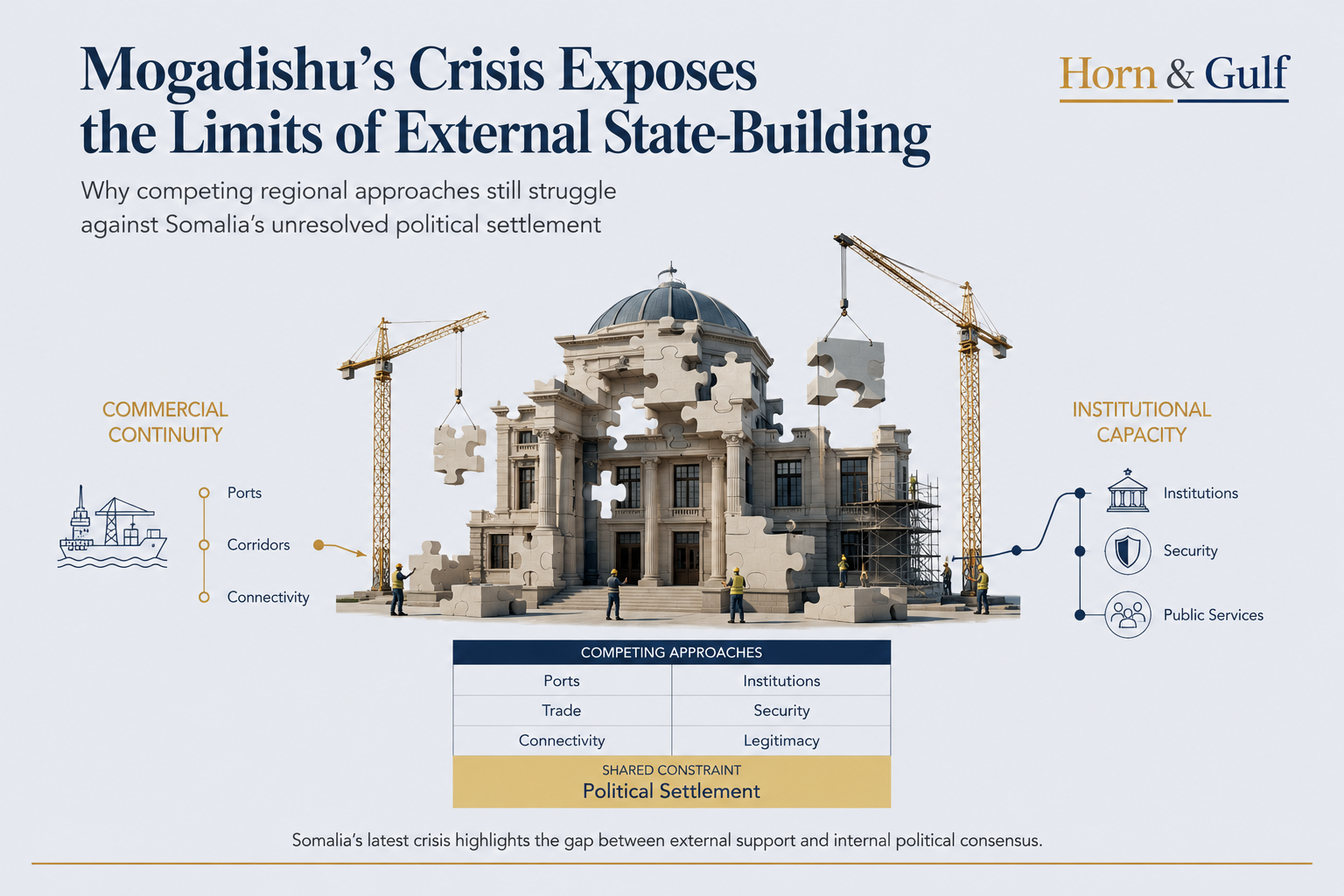
The latest violence in Mogadishu is not only a Somali security story. It is also an opportunity to reassess how different external actors have approached Somalia over the past decade — and where those approaches may be encountering their limits.
The most credible reporting so far does not support claims that Villa Somalia was captured by al-Shabaab. The stronger evidence points instead to clashes between federal security forces and opposition-aligned armed groups amid disputes over presidential authority, constitutional changes and the electoral process.
That distinction matters.
If the episode were primarily an al-Shabaab operation, the policy discussion would focus on counterterrorism. If it is a confrontation between state institutions and opposition-linked armed actors inside the capital, the question becomes broader: why do moments of political transition in Somalia continue to generate security crises?
For external partners that have invested heavily in Somalia’s future, that question is becoming increasingly difficult to ignore.
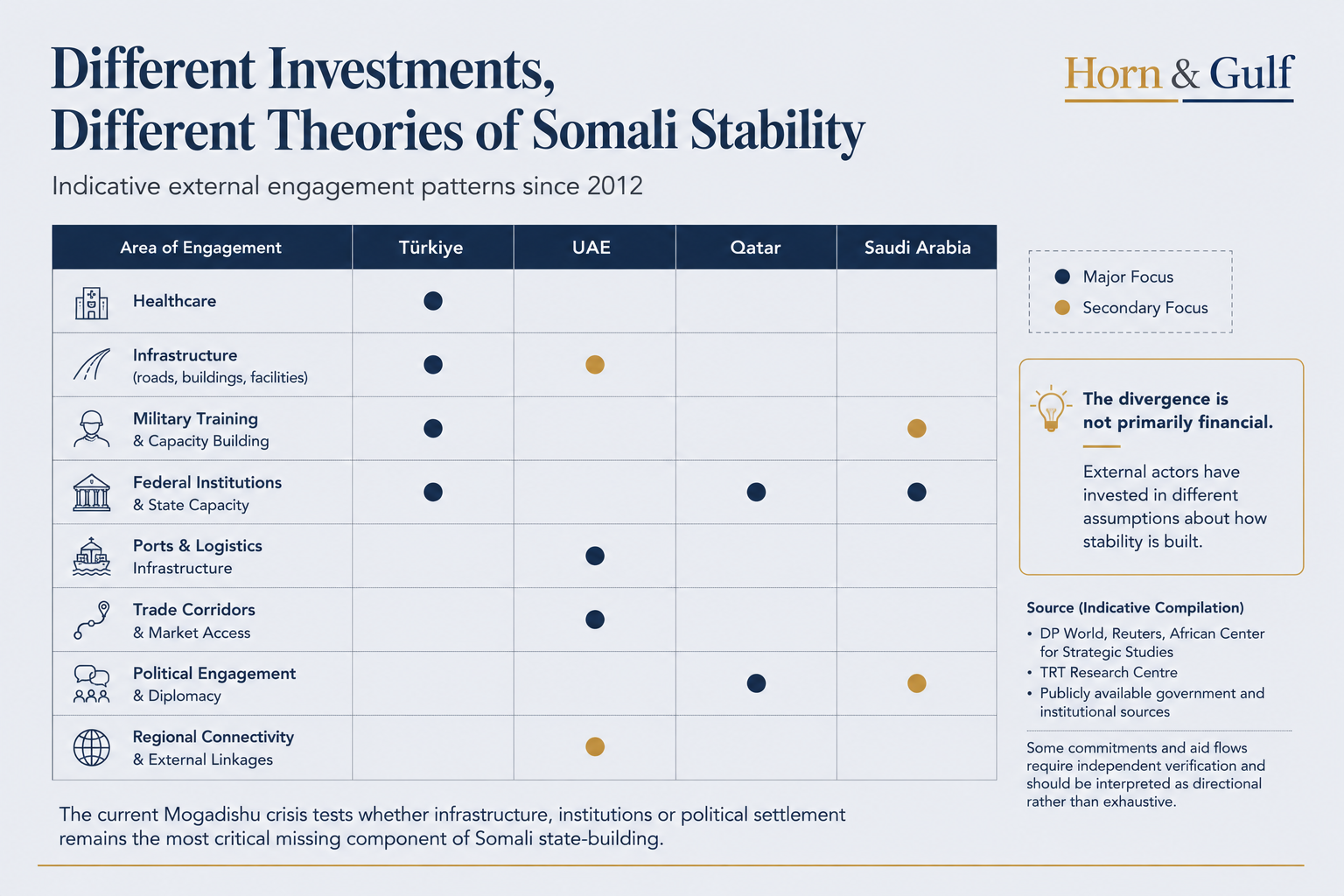
Over the past decade, Türkiye, the UAE, Qatar, Saudi Arabia and other regional actors have supported Somalia through different frameworks. Some have concentrated on strengthening federal institutions and state capacity in Mogadishu. Others have focused more heavily on trade infrastructure, ports and commercially significant regional geographies.
The latest crisis does not conclusively validate one approach or invalidate another. It does, however, highlight the challenges that all of them continue to face.
Different Approaches to the Same Problem
In some Gulf policy and commercial circles, there has long been skepticism about whether a Mogadishu-centered model alone can provide sufficient stability for long-term investment and regional connectivity.
This helps explain sustained interest in locations such as Somaliland and Puntland, as well as infrastructure projects linked to ports and trade corridors. Berbera, for example, has often been viewed through the lens of commercial connectivity, logistics development and regional trade access.
Recent events in Mogadishu are likely to reinforce arguments among observers who believe that Somalia’s state-building challenge cannot be addressed through the federal capital alone.
At the same time, this perspective has limitations.
Port development, logistics infrastructure and commercially successful local environments can contribute to economic resilience, but they do not by themselves resolve questions surrounding national legitimacy, constitutional arrangements or sovereignty. Those issues remain central to Somalia’s long-term political future.
For that reason, infrastructure-led approaches may alleviate some challenges without necessarily addressing the broader political questions that continue to shape the Somali state.
Türkiye’s Focus on Federal Institutions
Türkiye has pursued a different path.
Its engagement has largely focused on supporting federal institutions through infrastructure projects, humanitarian assistance, healthcare, security cooperation, military training and diplomatic engagement.
Over time, this has given Türkiye a substantial presence within Somalia’s institutional landscape. Turkish-supported projects are visible not only within government circles but also through public-facing services and infrastructure.
Yet the latest developments in Mogadishu illustrate an important limitation of external state-building efforts.
International partners can help strengthen institutions, improve service delivery and enhance security capabilities. They have far less influence over how domestic political actors choose to manage competition, transition and power-sharing.
This is not unique to Somalia. State capacity and political consensus are related, but they are not the same thing.
A government can become administratively stronger while remaining politically contested.
Qatar, Saudi Arabia and the Challenge of Political Consensus
Qatar and Saudi Arabia have approached Somalia through different diplomatic channels and regional priorities. Nevertheless, both have generally supported the federal state’s international legitimacy and Somalia’s territorial integrity.
The latest crisis highlights a challenge that extends beyond any single external actor.
Recognition, aid, security cooperation and diplomatic support can reinforce institutions. They cannot substitute for political consensus among domestic stakeholders.
This remains one of the central constraints facing Somalia’s international partners.
Somaliland and Mogadishu: Different Strengths, Different Constraints
Comparisons between Somaliland and Mogadishu are often politically sensitive, but they continue to shape regional discussions.
Somaliland has developed a degree of local administrative continuity, electoral experience and commercial predictability despite remaining internationally unrecognized.
Mogadishu, meanwhile, remains the internationally recognized center of the Somali state and continues to benefit from diplomatic support, development assistance and international engagement.
Each presents a different set of strengths and constraints.
Somaliland’s challenge remains diplomatic recognition and international status.
Mogadishu’s challenge remains the management of recurring political competition within the federal framework.
External actors have often placed different emphasis on these realities. Some prioritize functionality and commercial continuity. Others prioritize institutional legitimacy and federal state development.
Neither approach fully resolves the broader Somali political question.
The al-Shabaab Factor
Al-Shabaab does not need to be the primary actor in the latest clashes to benefit from political instability.
Periods of internal confrontation can divert attention, resources and political capital away from security reform, economic development and governance priorities.
This does not mean the current crisis should be understood primarily through the lens of al-Shabaab. However, prolonged political uncertainty can create conditions that complicate counterinsurgency efforts and weaken public confidence in state institutions.
That remains an important risk regardless of how the current confrontation develops.
What the Crisis Does — and Does Not — Tell Us
There is a temptation to interpret the latest violence as evidence that one external approach has succeeded while another has failed.
The evidence does not support such a conclusion.
Infrastructure-led engagement has produced tangible commercial and logistical benefits in some locations. Institution-focused engagement has contributed to state capacity and public services in others.
The more restrained conclusion is that Somalia’s internal political settlement remains incomplete, and that no external strategy can fully compensate for that reality.
External actors can support institutions, infrastructure and development. The long-term durability of those gains ultimately depends on domestic political arrangements.
Indicators to Watch
Several developments will help determine whether the current crisis proves temporary or more consequential.
- Whether the presidency and opposition return to structured political dialogue.
- Whether armed actors withdraw from politically sensitive areas of Mogadishu.
- Whether regional partners issue additional public statements or diplomatic initiatives.
- Whether al-Shabaab attempts to exploit the situation operationally.
- Whether discussions around federalism, autonomy and constitutional arrangements intensify.
- Whether international donors shift greater attention toward political settlement mechanisms.
These indicators are likely to be more revealing than social media claims or unverified battlefield narratives.
A Necessary Note of Caution
Important details remain contested.
Claims regarding casualty figures, weapon systems used and aspects of the operational timeline require further verification. It is also possible that mediation efforts reduce tensions and return the crisis to the pattern of political confrontation followed by negotiated compromise that Somalia has experienced before.
Somalia has repeatedly demonstrated both fragility and resilience.
For that reason, it would be premature to describe the current episode as either a transformational turning point or a temporary incident.
The evidence remains incomplete.
Conclusion
The latest Mogadishu crisis does not demonstrate that any single external actor has found the definitive answer to Somalia’s challenges.
What it does show is that Somalia’s difficulties cannot be reduced to a single dimension.
Infrastructure matters.
State institutions matter.
Security capacity matters.
Political consensus matters as well.
Over the past decade, different external actors have focused on different parts of that equation. The current crisis serves as a reminder that progress in one area does not automatically resolve weaknesses in another.
For now, the central issue remains unchanged: Somalia’s long-term stability will depend not only on external support, but also on the ability of domestic political actors to develop durable mechanisms for managing competition, transition and power-sharing within the state.