The UAE France defence agreement reflects a broader transformation in Gulf security thinking. Beyond military coordination alone, the agreement highlights how Gulf states are increasingly linking defence strategy to infrastructure resilience, maritime continuity and long-term economic stability.
As regional tensions continue to affect shipping routes, energy systems and investor confidence, defence partnerships are becoming part of a wider continuity-based security architecture across the Gulf.
The renewed defence cooperation agreement between the UAE and France arrives at a moment when Gulf security is being viewed through a wider strategic lens. Across the region, defence planning is becoming increasingly connected to infrastructure resilience, energy continuity, maritime access, aviation security and long-term economic stability.
At the surface level, the agreement reflects the continued deepening of military and strategic ties between Abu Dhabi and Paris. But the broader significance lies in what this says about the evolving architecture of Gulf security itself.
The Gulf today is no longer operating within a narrow energy-security framework. It is increasingly functioning as an interconnected system of ports, logistics corridors, financial centres, aviation networks and strategic infrastructure. In such an environment, defence cooperation becomes closely linked to continuity management.
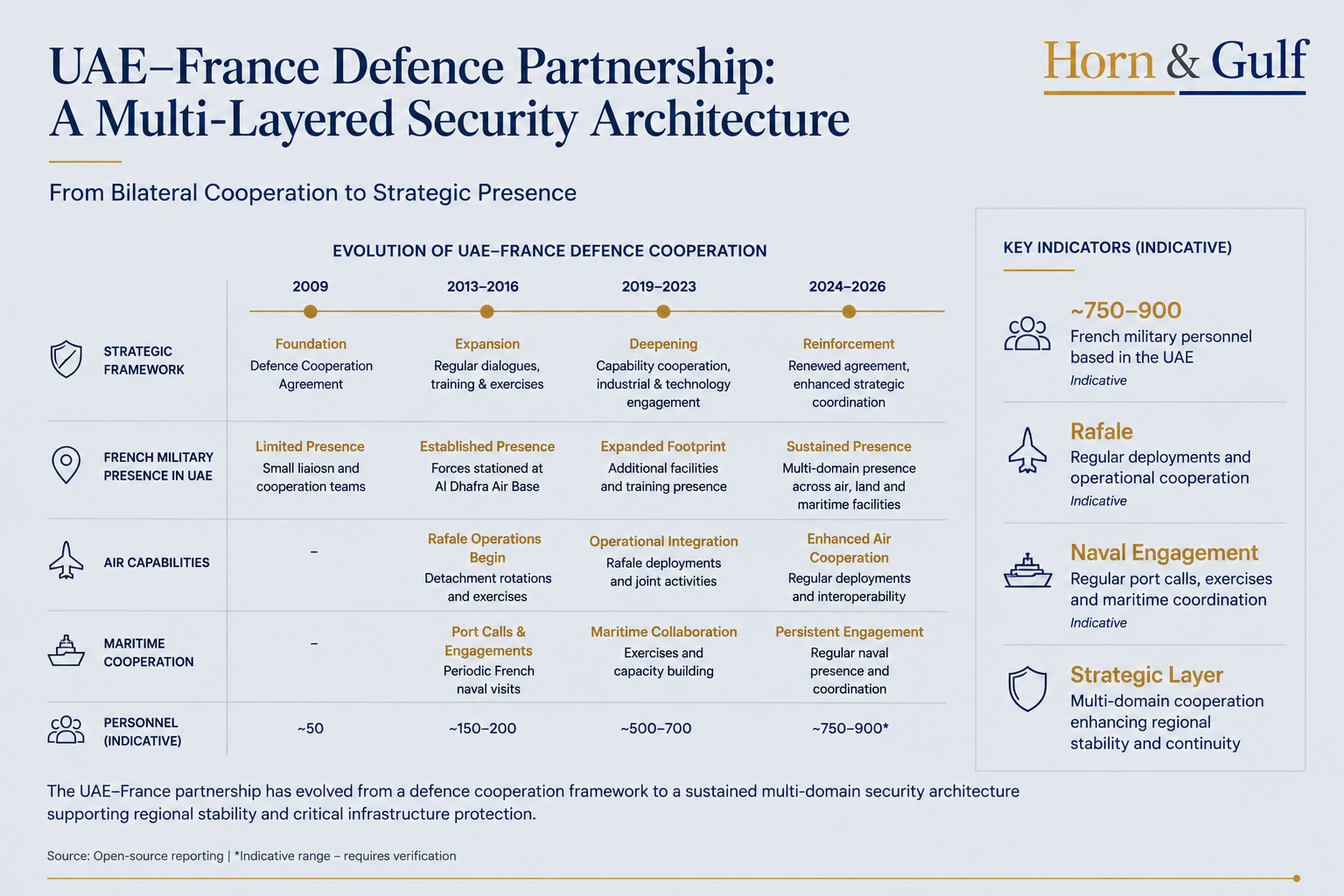
France’s role in this equation is therefore important not simply because of bilateral relations, but because Paris already forms part of the wider Gulf security environment through its long-standing regional military presence and defence cooperation with Gulf partners. The latest agreement appears less like the creation of a new strategic direction and more like the reinforcement of an existing layer within a broader security structure.
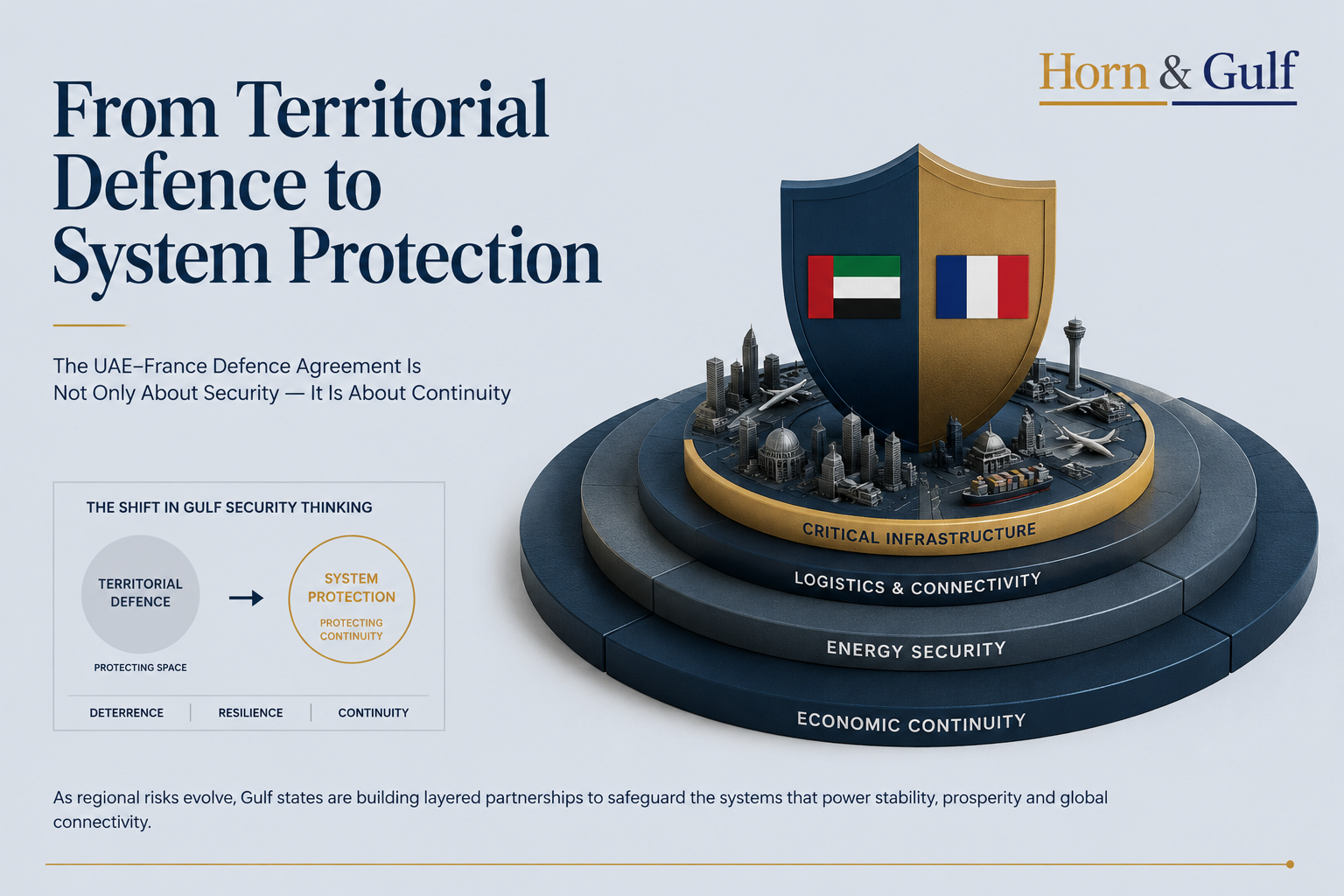
From Territorial Defence to System Protection
Traditional readings of Gulf defence partnerships often focus on deterrence, military procurement or alliance politics alone.
That framework is becoming increasingly incomplete.
The UAE today is protecting not only territory, but also connectivity. Ports, pipelines, airports, digital infrastructure, maritime routes and financial systems now sit alongside conventional defence considerations. Regional tensions in recent months have further reinforced the importance of infrastructure security and operational continuity across the Gulf.
This shift matters because the Gulf’s economic model has become deeply tied to reliability.
Energy flows, shipping routes, insurance calculations, aviation networks and capital movement are no longer isolated sectors. They increasingly operate as part of one integrated strategic ecosystem. As a result, regional defence relationships now carry implications beyond military coordination alone.
The Gulf’s New Strategic Logic
The deeper story behind the UAE–France agreement is not simply military cooperation. It is the emergence of a more layered Gulf security model.
The United States remains central to the region’s defence environment. At the same time, Gulf states are gradually broadening strategic partnerships in ways that enhance flexibility, resilience and operational depth.
Within this context, France provides additional strategic value through defence-industrial cooperation, naval access, air capabilities and long-term institutional coordination. This reflects a broader regional trend toward diversified partnerships without abandoning existing alliances.
This is not a replacement strategy.
It is a resilience strategy.
A more diversified security architecture reduces concentration risk and allows states to manage uncertainty across multiple strategic domains simultaneously.
Defence, Confidence and Capital
One of the most underappreciated dimensions of Gulf security today is the relationship between defence and investor confidence.
For states such as the UAE, continuity itself has become a strategic asset.
Real estate, aviation, tourism, finance, free zones, logistics and sovereign investment flows all rely heavily on perceptions of stability, operational reliability and institutional capacity. In this environment, defence cooperation increasingly serves not only military objectives, but also broader economic reassurance functions.
The significance of agreements such as this therefore extends beyond defence ministries.
They contribute to a wider perception that Gulf states are actively strengthening the resilience of critical systems at a time of elevated regional uncertainty.
That distinction is important.
Markets do not only evaluate military power. They also evaluate whether states can preserve continuity under pressure.
The Gulf Is Moving Toward a Continuity-Based Security Model
The UAE–France agreement reflects a broader transformation taking shape across the Gulf.
The region’s strategic focus is gradually shifting from the narrow protection of energy infrastructure toward the wider protection of interconnected systems. Hormuz, Red Sea shipping routes, logistics corridors, maritime insurance, aviation security and capital flows increasingly belong to the same geopolitical landscape.
This is changing how Gulf security is understood.
The region is no longer defined only by energy production capacity. It is increasingly defined by its ability to maintain continuity across complex networks of trade, finance, logistics and infrastructure.
In this environment, resilience itself becomes part of geopolitical influence.
And continuity becomes part of strategic pricing.