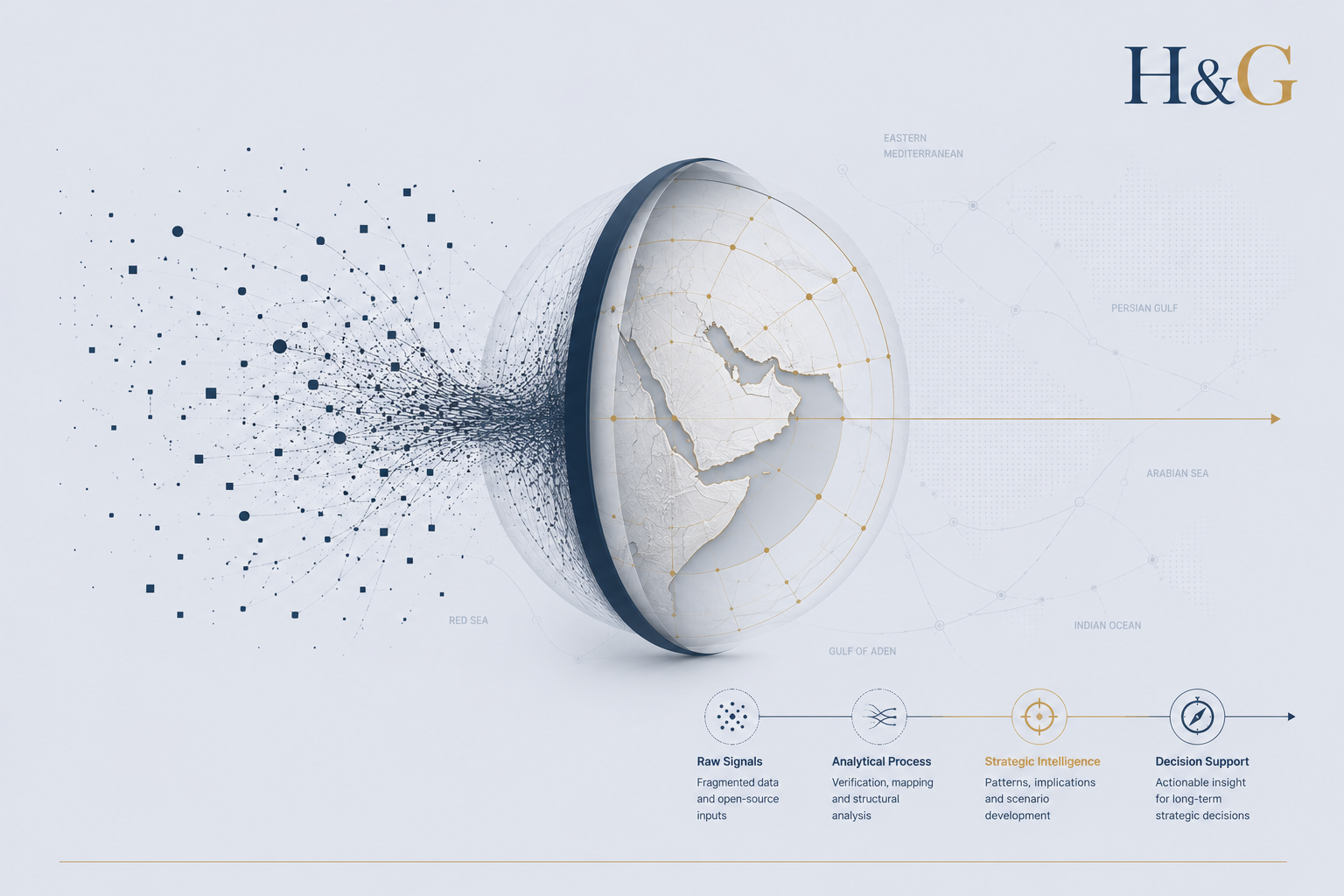
This section presents our in-depth reports and strategic assessments — designed to decode complex geopolitical developments into structured insights, with a focus on risk, systems and long-term transformation across the Red Sea, the Horn of Africa and the Gulf.
When Looking at Dubai, the Risk Is Not the Crisis — It Is Losing the Sense of Scale
Hormuz Is Not the Crisis — It Is a Signal Within a Larger System
For weeks, global attention has been fixed on a single question: whether the Strait of Hormuz will reopen.
The Red Sea Is No Longer a Route — It Is a Control Layer
For decades, the Red Sea was treated as infrastructure. A corridor. A passage connecting production and consumption. Ships entered from one end, exited from the other, and the system held.
From Ports to Power: How Logistics Became Security
Ports were once endpoints. They marked the arrival of goods, the interface between sea and land, the logistical backbone of trade.
Non-State Actors Are Now System Operators
For much of modern geopolitical analysis, non-state actors have been treated as disruptors
Berlin Sudan Conference: Not a Failed Meeting, but a Fragmenting System
The international conference on Sudan held in Berlin looked, at first glance, like a familiar story: pledges of aid, calls for ceasefire, and whispers of tension behind closed doors.
From Hormuz to Dubai: Flow Is Back — Control Never Left
The recent normalization of transit through the Strait of Hormuz has been widely interpreted as a return to stability. Tankers are moving, insurance pressure has eased at the margin, and the immediate sense of disruption has receded.
The Strait Is Open But Not Free: Inside the New Hormuz Reality
The Strait of Hormuz is not closed. But it is no longer open either. What emerged over the last 24 hours is something far more complex — and far more dangerous
Bab Al-Mandeb Is Not the Prize — Production Is
In the Somalia file, what is being discussed today is neither wrong nor irrelevant—but it is fragmented. The core problem is not the absence of information; it is the inability to read the system as a whole.
Blockade vs Flow: The Navy Can Intercept Ships. It Cannot Fully Map the System
The numbers don’t match — and that’s the signal. Naval control is visible. Oil flows are not. This is not disruption. It is repricing.
Horn of Africa: The Other Side of Hormuz
As pressure builds in Hormuz, the Horn of Africa is no longer a fallback route. It is emerging as a structural layer of the global maritime system—reshaping how trade, risk and control are distributed across corridors.
Red Sea Security: Horn of Africa Power Shifts and Their Impact on Global Trade Stability
The Red Sea is no longer just a trade route. Power shifts across Eritrea, Djibouti, Somaliland and Sudan are turning it into a layered control system shaping global logistics and risk.
Gulf Sovereign Investment Surge: How Middle East Capital Is Repricing Risk During Conflict
Gulf sovereign capital shift is no longer a cyclical reaction to geopolitical risk. It is actively reshaping how capital flows, ownership structures and private financial channels evolve across global markets.
Hormuz Risk and Saudi Strategy: How Gulf Energy Flows Are Being Repriced
Hormuz risk is no longer a temporary disruption. It is reshaping Gulf energy flows, increasing systemic costs and redefining how risk is priced across the region. What is unfolding is not a breakdown of energy movement, but a structural repricing of the Gulf system itself.
Dubai Air Traffic Recovery: How a 66% Collapse Turned Into a System Resilience
Dubai air traffic recovery is not just an aviation story. It reveals how DXB moved from a sharp March disruption to a rapid May rebound once airspace access returned.
Hormuz and the Red Sea Are Being Repriced: How Gulf Shipping Risk Is Reshaping Global Trade and Energy Flows
Hormuz Red Sea shipping risk is no longer a temporary disruption. It is reshaping global trade routes, energy flows and cost structures as maritime access shifts from open transit to controlled systems.
Sudan Conflict and Eritrea Tensions Are Reshaping Red Sea Geopolitics
Red Sea geopolitics is no longer limited to shipping lanes and naval patrols. Sudan’s conflict and Eritrea’s strategic position are reshaping maritime security, Gulf influence and regional risk across the Horn of Africa.
Turkey’s Blue Homeland Is Expanding Beyond the Mediterranean
Turkey’s maritime strategy is increasingly connecting the Mediterranean, Red Sea and Gulf through strategic access points and maritime corridors.
IMEC and Blue Homeland Reflect Competing Approaches to a Changing Global System
IMEC and Blue Homeland reflect two different approaches to the same strategic shift: the growing importance of resilient connectivity systems.
Asia Cannot Replace Gulf Crude Easily! Because the Gulf Has Become Part of Asia’s Industrial Architecture
Asia Gulf crude dependency remains one of the defining structural realities of the global energy system.
The UAE–France Defence Agreement Is Not Only About Security It Is About Continuity
The UAE–France defence agreement reflects the Gulf’s transition from territorial defence toward continuity protection and infrastructure resilience.
Hormuz and the Logistics Stress Test Beneath Gulf Industrialization
Hormuz disruption increasingly affects industrial continuity, not only energy exports.
Africa Is Not Outside the Iran Crisis But Exposure Is Not the Same as Destiny
The Gulf–Red Sea–Horn corridor is increasingly functioning as an interconnected risk environment rather than isolated regional theatres.
Saudi Nuclear Enrichment and the Limits of U.S. Consistency in the Gulf
Saudi nuclear flexibility is increasingly shaping the debate around U.S. non-proliferation consistency in the Gulf.
Gulf Escalation Tests the Region’s Economic Predictability
The latest escalation is testing the Gulf’s reputation for operational predictability, not only its energy security.
Ethiopia’s Budget Has a Gulf Crisis Line Item
How a Gulf security shock became a fiscal variable in the Horn of Africa.